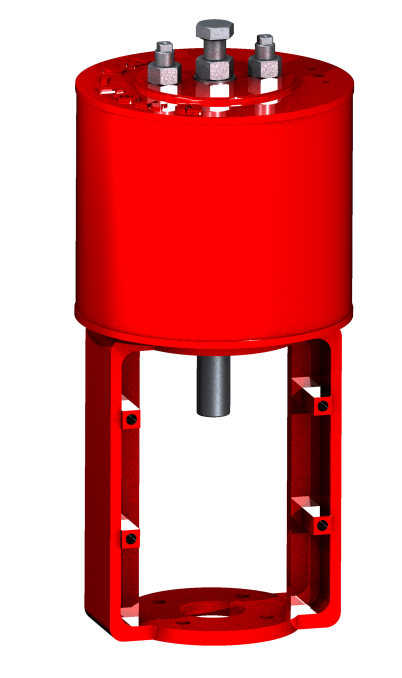
SUZHOU, JIANGSU, CHINA, August 28, 2026 /EINPresswire.com/ — STARD GEARS provides Double Acting Pneumatic Actuator solutions designed to deliver precise bidirectional thrust in industrial valve automation. Through precise air supply to both sides of the LSP series piston, these systems offer robust actuation for rising-stem gate, globe, and control valves. Delivering up to 380 kN thrust and 610 mm strokes, engineers can select the ideal pneumatic profile for demanding pipelines.
The Double Acting Pneumatic Actuator Delivers Controlled Force in Both Directions
Managing automated pipeline flow requires mechanisms capable of precise movement during opening and closing cycles. A double-acting pneumatic system provides this by utilizing compressed air to drive the extension and retraction of its internal piston. This bidirectional force is crucial for valves where processes dictate active control over the full travel distance instead of relying on a passive mechanical return.
STARD GEARS manufactures the LSP series using a modular linear pneumatic piston architecture to handle cut-off and regulating duties for rising-stem valves. Bypassing mechanical losses seen in rotary conversions, the actuator converts air pressure directly into thrust. This direct-drive approach guarantees consistent force, helping operators achieve tight shut-off in isolation setups and smooth positioning in critical control environments.
For quarter-turn automation, STARD GEARS separates this linear duty from the YP Series Scotch Yoke actuator, which is designed for 90-degree ball, butterfly, and plug valves and is available in double-acting or spring-return configurations. This selection boundary keeps linear thrust sizing and quarter-turn torque sizing tied to the correct valve motion.
Accommodating diverse valve sizes demands a comprehensive product family. The LSP series meets this need with thrust capacities up to 380 kN, strokes reaching 610 mm, and cylinder diameters up to 900 mm. Whether automating a utility line or main header, a suitable solution exists. Procurement teams must calculate air consumption and factor in local storage, since this structure relies on continuous air supply.
Thrust and Travel Must Match the Valve Across the Full Stroke
Selecting the right actuator involves more than checking required forces at stroke endpoints. A reliable package must deliver sufficient power across the entire travel path to overcome dynamic friction, differential pressures, and constant stem loads. Engineering teams must evaluate the full thrust curve and verify that the chosen cylinder maintains an adequate safety margin during all operational phases.
Theoretical thrust is determined by working pressure, ranging from 3 to 10.5 barg for the LSP series, acting upon the piston’s area. To translate theoretical power into actual stem force, the manufacturer incorporates low-friction seals and optional chrome-plated cylinder. These features minimize sliding resistance and wear, ensuring more pneumatic energy is delivered directly to the valve stem rather than lost to internal friction.
Different valve types impose distinct hardware demands. For control valves, engineers prioritize regulating precision, positioner compatibility, minimal deadband, and high-frequency movement. Conversely, isolation valves require maximum end-position thrust for tight seating. In both scenarios, the mechanical interface—including the valve stem connection, internal guides, potential side loading, and physical orientation—must be rigorously reviewed to ensure long-term reliability.
Temperature and Manual Operation Extend Industrial Availability
Industrial facilities often face harsh conditions. Actuators routinely endure extreme heat, freezing outdoor temperatures, and utility interruptions. To maintain plant availability, the pneumatic system must handle these environmental extremes and sudden failures. The temperature resilience and manual override options built into the LSP series allow these actuators to perform reliably across a broad spectrum of demanding environments.
The standard sealing package of the LSP actuator covers temperatures from -20°C to 100°C. For specialized processes, construction can be adapted. Upgrading internal components extends the operational envelope down to -40°C or up to 204°C. This flexibility enables engineers to standardize on a single actuator family across different climate zones and process areas, significantly simplifying the site’s maintenance inventory.
To address air supply disruptions, a side-mounted handwheel option is available. This manual override can be engaged between fully open and closed positions, allowing personnel to safely stroke the valve during commissioning, servicing, or unexpected air failures. Depending on actuator size and available space, the override can utilize a screw mechanism, mechanical gearbox, or hydraulic system, making early layout decisions essential.
Low-Friction Seals and Chrome-Plated Bores Support Repeated Linear Motion
Frequent cycling wears down any mechanical system. For control applications requiring constant flow rate adjustments or batch processes needing continuous cycles, internal wear components dictate lifespan. The inclusion of low-friction piston seals and chrome-plated cylinder bores in the LSP series establishes the necessary design foundation to support this repeated linear motion without premature degradation.
Low-friction seals are essential for maintaining control accuracy. By minimizing resistance against the cylinder wall, seals prevent the stick-slip phenomenon that causes erratic valve positioning. This guarantees the bidirectional air supply is predictably converted into linear stem thrust. When the system signals an adjustment, the actuator responds immediately and proportionally, holding the process variable on target.
While a chrome-plated bore enhances durability by providing a smooth surface for seals, it remains just one factor in equipment lifespan. Maintenance teams must still evaluate anticipated cycling frequencies, specific temperature versions, plant air supply cleanliness, and maintenance intervals. A robust design offers a strong baseline, but long-term reliability requires aligning hardware capabilities with actual operating conditions.
Model Selection, Accessories and Documents Complete the Automation Package
Procuring a valve actuator involves acquiring a complete automation package integrating seamlessly into a plant’s control architecture. To guarantee a successful installation, procurement teams must treat the selection of the LSP model, stem interface, control accessories, testing protocols, and final delivery documentation as a single unified approval process.
Sizing the package accurately demands comprehensive engineering input. Technical reviews must encompass the specific valve type, dynamic thrust curve, required stroke length, available air pressure, ambient temperature, stroking time, cycle frequency, and physical installation direction. Only when these variables are defined can teams confirm the correct cylinder configuration.
Equally critical are control accessories. Selected positioners, solenoid valves, limit switches, and air preparation units must be fully compatible with the double-acting system’s pressure rating and logic. Before finalizing orders, parties must define deliverables, including dimensional outlines, interface drawings, formal calculations, and test reports. For international projects, packaging and export compliance documents must be confirmed early to prevent delays.
Double-Acting LSP Approval Centers on Bidirectional Valve Load
Finalizing the specification for a double-acting system requires focusing strictly on the valve’s bidirectional demands. The chosen model must generate the necessary thrust independently in both directions, ensuring consistent performance across the full stroke while adhering to the facility’s pressure, temperature, and mechanical interface constraints.
While adding a side-mounted handwheel provides a crucial safety feature, it remains an intervention option. A manual override does not alter the fundamental operating logic of the double-acting structure, which inherently depends on a reliable two-way air supply to consistently execute its automated cycles.
Automation engineers and procurement teams ready to configure a linear actuation package can submit their bidirectional load requirements and operational frequencies to the manufacturer. For comprehensive support, sizing confirmation, and to explore the full capabilities of the LSP series, visit https://www.stard-gears.com/.
Suzhou SIP Stard Automation CO.,LTD.
STARD GEARS
email us here
Visit us on social media:
LinkedIn
YouTube
Legal Disclaimer:
EIN Presswire provides this news content “as is” without warranty of any kind. We do not accept any responsibility or liability
for the accuracy, content, images, videos, licenses, completeness, legality, or reliability of the information contained in this
article. If you have any complaints or copyright issues related to this article, kindly contact the author above.

Media gallery