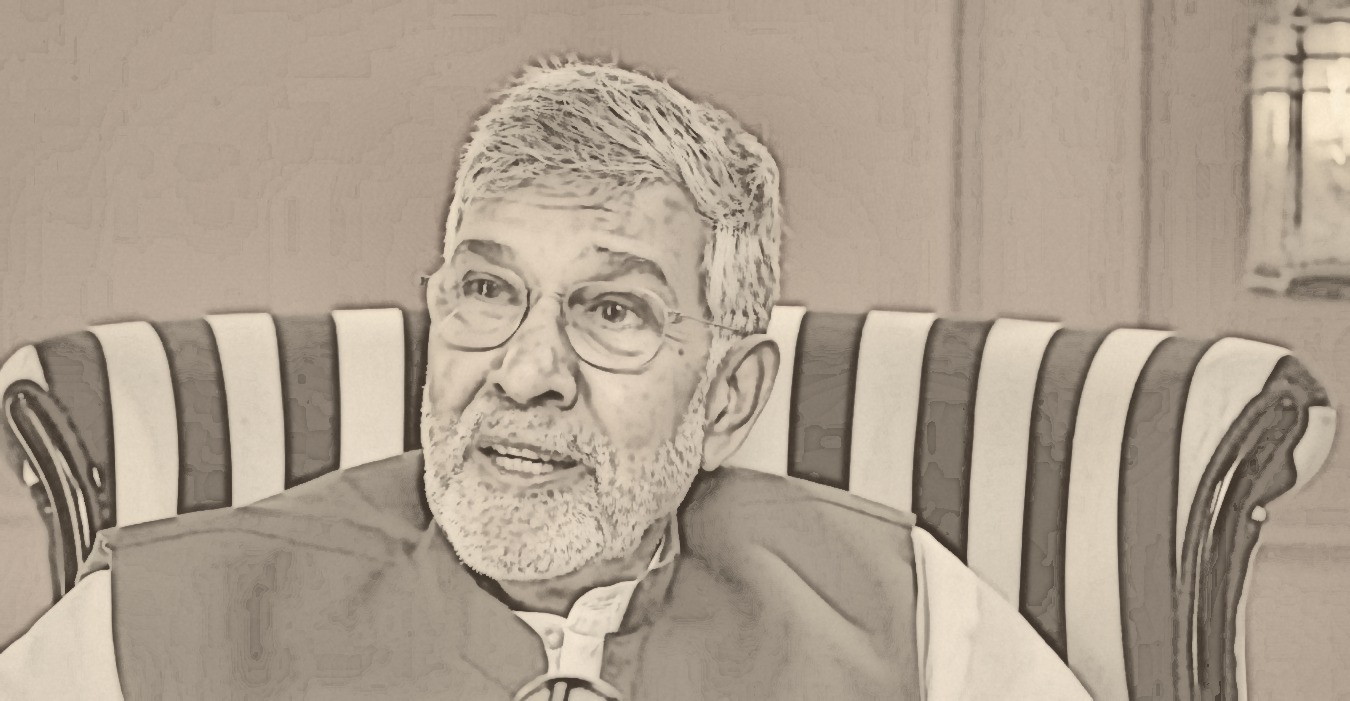

Kailash Satyarthi discusses the campaign behind the GoodWeave label, compassion as a force for action and why the people who build AI need moral responsibility.
SAN FRANCISCO, CA, UNITED STATES, November 22, 2026 /EINPresswire.com/ — Tomorrow, Today, the long-form interview series created and hosted by Shekhar Natarajan, has released a new episode featuring Kailash Satyarthi, the child rights activist who shared the 2014 Nobel Peace Prize. The conversation covers his decades of work against child labor, the consumer campaign that led to the first child-labor-free label for handmade carpets and his call to make compassion a guiding principle for leaders and for the people who build artificial intelligence (AI).
Satyarthi recalls how a night in a railway police lockup, after he tried to stop children from being taken to carpet workshops, convinced him that complaints alone would not end the practice. Because most handmade carpets from the region were exported, he turned to consumers in Europe and the United States and persuaded a German partner organization to launch a consumer campaign. He describes promising a television viewer that a label guaranteeing carpets made without child labor would exist within a few years. That effort became Rugmark, now known as GoodWeave.
Topics covered in the episode include:
– How the carpet campaign and labeling system changed incentives for importers, exporters and consumers
– Why he believes courage comes from compassion
– His redefinition of compassion as a force for action rather than a soft emotion, the subject of his book “Karuna: The Power of Compassion”
– The four elements he sees in compassion: awareness, connectedness, feeling and action
– His call for “compassionate intelligence” and for training the people who design, build and deploy AI systems
– His concern that AI could concentrate knowledge, wealth and decision-making power in a few hands
– The Compassion Quotient (CQ), a measure he proposes for individuals and organizations alongside IQ and emotional intelligence
Satyarthi describes compassion as a force “born from feeling the sufferings of others as your own” that drives people to take mindful action, and he argues that kindness and charity alone cannot solve deep-rooted, systemic injustice. Applied to technology, he said, that means building moral responsibility into every stage of AI development, from defining the problem and collecting data to deployment. “The machine cannot feel, but the human behind the machine can feel,” Satyarthi said.
He also argues that, unlike IQ, compassion can be measured and strengthened, and that people may one day choose employers based on an organization’s CQ.
The conversation also turned to the framework Natarajan uses to think about trustworthy AI: perceiving a situation correctly, choosing the right action and acting with moral consistency. “I cannot be apathetic on Monday, very kind on Tuesday and cynical on Wednesday. If I don’t get the same answer twice, how do I trust the system to make a decision on my behalf?” said Shekhar Natarajan, host of Tomorrow, Today.
The full episode is available on YouTube: https://www.youtube.com/watch?v=MQ5IysNsJh4
About Tomorrow, Today
Tomorrow, Today is a long-form interview series created and hosted by Shekhar Natarajan. The show features conversations with entrepreneurs, innovators, policymakers, scientists, educators and thought leaders on the technologies, ideas and decisions shaping the future, from artificial intelligence and business to leadership and education. Episodes are available on YouTube and major podcast platforms.
About Kailash Satyarthi
Kailash Satyarthi is an Indian child rights activist who shared the 2014 Nobel Peace Prize with Malala Yousafzai “for their struggle against the suppression of children and young people and for the right of all children to education.” Trained as an electrical engineer, he left that career in 1980 to found Bachpan Bachao Andolan (Save the Childhood Movement). He conceived the 1998 Global March Against Child Labour and founded Rugmark, now GoodWeave International. His organization reports that it has helped rescue more than 138,000 children from child labor, trafficking and slavery.
About Shekhar Natarajan
Shekhar Natarajan is the founder and host of Tomorrow, Today and a former senior executive at American Eagle, Walmart, Target and Disney, where he led global initiatives in technology and supply chain strategy.
Shekhar Natarajan
Tomorrow Today Media
Visit us on social media:
LinkedIn
Instagram
Facebook
YouTube
X
Other
Kailash Satyarthi x Shekhar Natarajan | Tomorrow, Today
Legal Disclaimer:
EIN Presswire provides this news content “as is” without warranty of any kind. We do not accept any responsibility or liability
for the accuracy, content, images, videos, licenses, completeness, legality, or reliability of the information contained in this
article. If you have any complaints or copyright issues related to this article, kindly contact the author above.

Media gallery