

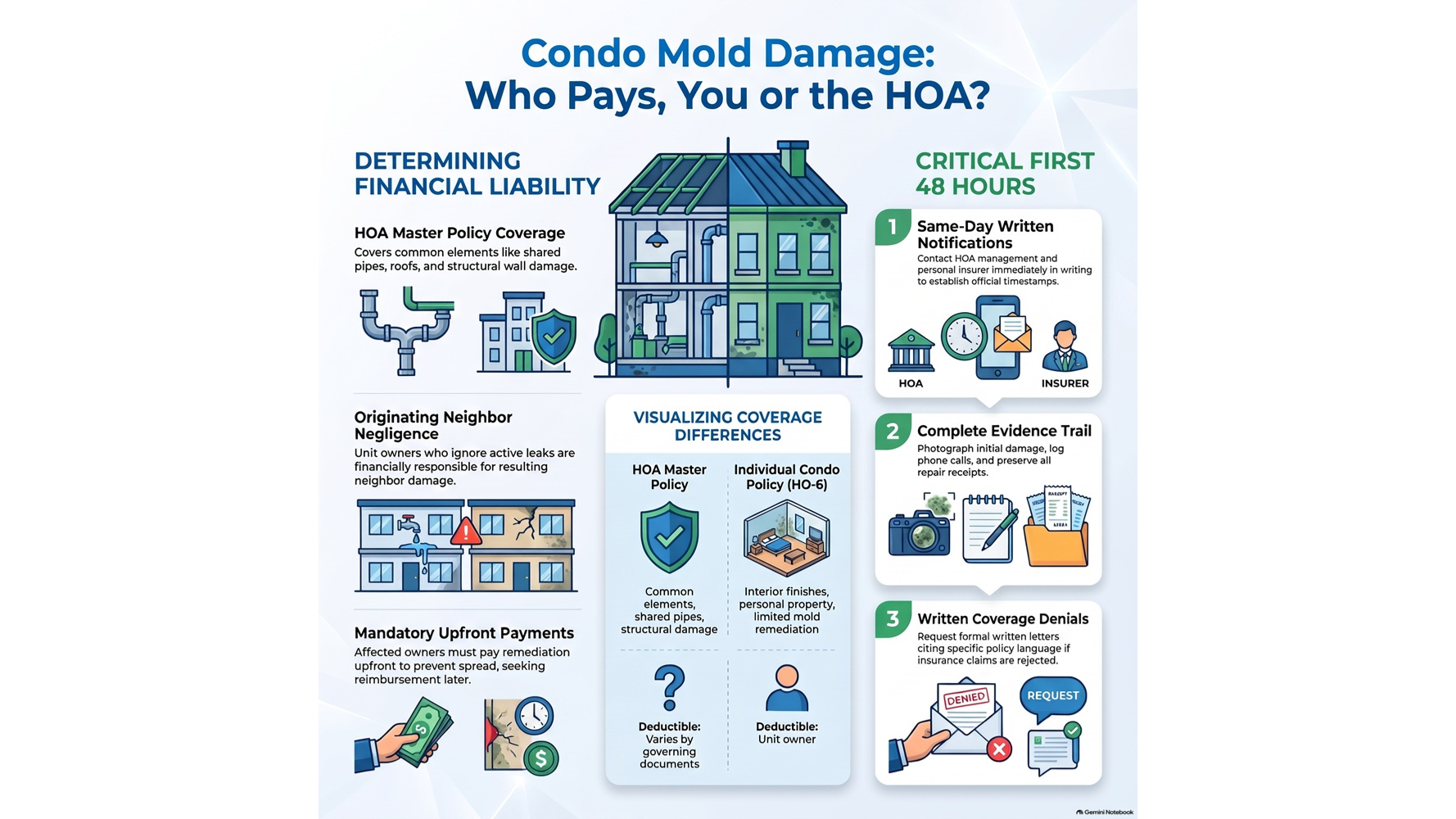
Key Takeaways
- Responsibility for condo mold damage depends on where the water came from, whether it affected a common element or a private unit, and what the governing documents and insurance policies say
- A shared pipe or common-element leak may fall under the HOA’s master policy, while a leak caused by a neighbor’s negligence may make that owner responsible instead
- Owners often have to pay for remediation upfront and seek reimbursement later through insurance or legal action, so saving every receipt matters
- Notifying the HOA and an insurer the same day damage is found, and reaching out in writing to a neighbor, can protect an owner’s position if the claim is disputed later
- Withholding HOA dues during a mold dispute can backfire, since governing documents often allow late fees or liens regardless of who caused the damage
Finding mold in a Tampa Bay condo often brings up one urgent question before any other: who has to pay to fix it? The answer is rarely simple, and condo owners who assume the HOA automatically covers the cost, or that their own policy will handle everything, sometimes learn the truth only after a dispute has already dragged on for weeks.
Who’s Liable: Owner, Neighbor, Or HOA?
Liability for condo mold damage shifts based on a handful of specific factors rather than a blanket rule. Where the water came from, whether the damaged area counts as a common element or part of a private unit, whether anyone acted negligently, and what the condo’s governing documents and insurance policies say all play a role in determining responsibility.
In many cases, the unit owner where a leak originated ends up responsible for mold damage that spreads into a neighboring unit. That said, being the party who is ultimately liable and being the party who pays first are two different things. A unit owner dealing with active mold growth often has to cover remediation costs out of pocket and pursue reimbursement afterward through an insurance claim or, if necessary, legal action against whoever caused the problem. The clearest cases usually involve identifying the water source early, before mold spreads and the evidence trail gets murky.
What Determines Responsibility For Condo Mold
A handful of factors combine to decide who pays for mold remediation in a condo, and none of them work in isolation. Understanding each piece makes it easier to predict how a claim is likely to be resolved.
Where The Water Came From
The physical source of the water matters more than almost anything else in a condo mold dispute. A leak from a shared pipe, a roof, or a structural wall that the association is responsible for maintaining often falls under the HOA’s duties, while water coming from a fixture or appliance that serves only one unit tends to be that owner’s problem. Florida law requires associations to repair, reconstruct, or replace condominium property damaged by an insurable event that the association is obligated to insure, treating that repair as a common expense. When no insurable event applies, responsibility instead follows whatever maintenance provisions appear in the declaration or bylaws, which is why reading those documents early saves a lot of guesswork later.
Common Elements Vs. Your Unit
Florida condo law draws a real line between association-insured property and property that belongs to the unit owner, and the exact split depends on which part of the building got damaged. Shared pipes, roofs, and structural walls generally fall under the association’s responsibility, while fixtures and appliances serving a single unit typically belong to that owner. Plumbing responsibility often comes down to whether a failed pipe serves more than one unit or sits inside a shared wall versus serving only one owner’s unit. That distinction explains why two nearly identical-looking leaks in the same building can have completely different outcomes for who pays.
Negligence And The Governing Documents
Even when the association is obligated to repair an insured common element, Florida law allows a separate question to come into play: whether negligence caused the damage in the first place. A unit owner can be held responsible for repair or replacement costs not covered by insurance when the damage traces back to intentional conduct, negligence, or a failure to follow the condo’s declaration or rules by that owner or someone in their unit. In practice, this means an association might repair damaged common elements right away and then seek reimbursement from a negligent owner afterward, if the governing documents allow it. Ignoring a known leak for weeks or skipping a required maintenance task are the kinds of behavior that tend to shift liability squarely onto the owner responsible.
Your First Moves After Finding Mold
What happens in the first day or two after spotting mold can shape the entire outcome of a claim. Acting quickly protects both the unit and the paper trail needed to prove what happened.
Notify The HOA And Your Insurer The Same Day
Reporting mold or water damage the same day it is discovered, rather than waiting, matters for more than just getting repairs started faster. Many governing documents require prompt notification, and delays can actually work against an owner if a dispute later arises over timing or cause. A phone call to the property management office followed by a same-day written email creates a timestamp that is hard to dispute later, and it is worth asking directly whether the HOA’s master policy applies to the specific situation. Calling the individual insurance provider that same day matters just as much, since insurers often enforce strict reporting windows that can affect coverage if missed.
Put It In Writing To A Responsible Neighbor
When the moisture appears to trace back to a specific neighboring unit, reaching out directly and in writing creates a documented record of the attempt to resolve things amicably. A simple, polite message describing what was found and when goes a long way if the situation eventually needs legal attention. This step also shows good faith, which can matter if the dispute ends up in front of an HOA attorney or, eventually, a court.
Why You May Pay Remediation Costs Upfront
Mold does not wait around for insurance approval or a liability determination before it keeps spreading. Because delaying treatment can make the damage worse and the health risks greater, many owners find themselves covering remediation costs out of pocket before anyone has agreed on who is ultimately responsible. Every receipt, estimate, and invoice collected during this period becomes part of the evidence needed to pursue reimbursement later, whether through an insurance claim or a direct demand to a negligent neighbor. This upfront cost can feel unfair in the moment, but it is often the only way to stop mold from damaging more of the unit while the liability question gets sorted out.
Checking HOA And HO-6 Policies
Before filing any claim, pulling both insurance policies and reading them closely prevents a lot of unpleasant surprises down the line.
What Each Policy Typically Covers
An HOA’s master policy and an individual owner’s HO-6 policy are built to cover different pieces of the same building, and knowing the difference ahead of time makes a dispute much easier to work through.
- The HOA master policy typically covers common elements such as shared pipes, roofs, and structural walls, since Florida law treats this property as the association’s responsibility to insure and repair as a common expense
- An HO-6 policy typically covers interior finishes like drywall and flooring, personal belongings, and in many cases certain built-in items such as cabinets and appliances that serve only the individual unit
- Florida law also requires residential condominium policies to include at least $2,000 in loss-assessment coverage for qualifying assessments tied to the same direct property loss, subject to statutory conditions and limits
Requesting a certificate of insurance from the HOA is a reasonable step before assuming either way what the master policy covers, since every condo association writes its documents a little differently.
Deductibles Can Land On Owners
Master policy deductibles can run into thousands of dollars, and depending on the governing documents, associations may pass some or all of that deductible along to affected owners. When the association’s insurance does not fully cover an insurable loss, Florida law generally treats the deductible and any remaining uncovered amount as a common expense, with one key exception: damage caused by an owner’s or occupant’s intentional conduct, negligence, or rule violation can shift that cost back onto the responsible party. This is part of why reviewing the condo’s CC&Rs and bylaws alongside both insurance policies matters so much before assuming who is footing the bill.
Evidence That Protects Your Claim
Condo mold disputes almost always come down to evidence in the end, and the owners who recover their costs fastest tend to be the ones who started documenting from the very first sign of trouble.
Photos, Emails, And Written Denials
A dated photo taken the day damage is discovered, followed by continued photos as remediation progresses, builds a visual timeline that is difficult to argue with later. Keeping copies of every email, text message, maintenance request, and repair estimate adds another layer of protection, especially a quick follow-up email after any phone call confirming what was discussed. If an insurer denies a claim, asking for that denial in writing, including the specific policy language cited, creates a document that becomes essential if the decision needs to be appealed or challenged later.
When An Independent Mold Inspection Helps
When the cause of the mold or the question of liability is disputed, an independent mold inspection separate from anyone sent by the HOA or an insurer can provide an unbiased read on what actually happened. A detailed written report that includes photos and moisture readings gives concrete data to support a position, whether that means negotiating with an insurer or demonstrating negligence by a neighbor. This kind of documentation often matters most in cases where multiple parties, such as an HOA, an individual insurer, and a neighboring owner, are all involved at once.
A Mistake That Can Backfire: Withholding Dues
Withholding HOA dues during a mold dispute might feel like a reasonable way to apply pressure, but it rarely works out well. Most governing documents allow the HOA to charge late fees or even place a lien on a unit for unpaid dues, regardless of whether a legitimate dispute is underway. Continuing to pay dues on time while pursuing documentation and, if needed, legal channels protects an owner’s standing and avoids adding an entirely separate financial problem on top of an already stressful mold situation.
Condo Mold Liability Is Case-By-Case
Every condo mold dispute in Tampa Bay hinges on its own set of facts: where the water came from, what the governing documents say, and what each insurance policy actually covers. No single rule decides whether the HOA, a neighbor, or an individual owner ends up paying, which is exactly why documentation, prompt notification, and a careful read of both policies matter so much from the first sign of trouble. Owners who treat the early hours after finding mold as a chance to build their case, rather than just a cleanup problem, tend to come out ahead when it is time to settle who pays. For help sorting out the source of a leak and getting a clear path toward cleanup, a professional mold remediation evaluation from TampaBayMold.net can make the difference between a drawn-out dispute and a resolved claim.
TampaBayMold.net
550 N. Reo St. Suite #300
Tampa
FL
33609
United States