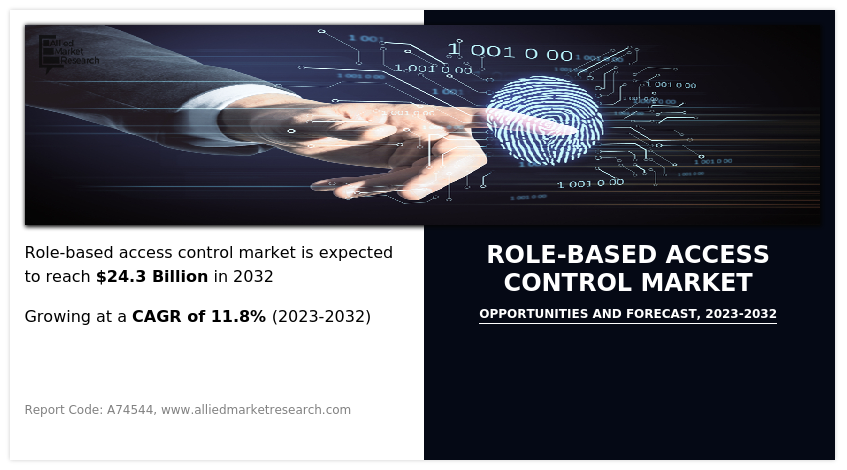
Role-Based Access Control market is projected to reach $24.3 billion by 2032, driven by cybersecurity and cloud adoption.
WILMINGTON, DE, UNITED STATES, June 3, 2026 /EINPresswire.com/ —
According to a new report published by Allied Market Research, the global role-based access control market size was valued at $8.3 billion in 2022 and is projected to reach $24.3 billion by 2032, registering a CAGR of 11.8% from 2023 to 2032. The increasing focus on cybersecurity, growing adoption of cloud computing, expansion of remote work environments, and rising investments in advanced digital technologies are driving significant growth in the market.
As organizations continue to digitize operations and manage larger volumes of sensitive information, controlling user access has become a critical component of enterprise security strategies. Role-based access control (RBAC) provides businesses with a structured framework to manage permissions efficiently, reduce security risks, and ensure regulatory compliance. These advantages are accelerating the adoption of RBAC solutions across industries worldwide.
Download PDF Brochure: https://www.alliedmarketresearch.com/request-sample/A74544
Understanding Role-Based Access Control
Role-based access control is a security model that restricts system access based on predefined user roles within an organization. Instead of assigning permissions individually to every employee, organizations create roles based on job functions and responsibilities. Users are then assigned to these roles, allowing them access only to the resources required for their specific tasks.
This approach simplifies security management while minimizing the risk of unauthorized access. By ensuring that employees can only view, modify, or interact with information relevant to their responsibilities, organizations strengthen data protection and improve operational efficiency.
The role-based access control market has gained significant momentum as enterprises seek scalable and automated methods to manage increasingly complex digital environments. With organizations adopting cloud platforms, Internet of Things (IoT) devices, artificial intelligence applications, and remote work infrastructures, managing user permissions effectively has become more important than ever.
Growing Cybersecurity Concerns Fuel Market Growth
The increasing frequency and sophistication of cyberattacks have elevated access management to a strategic priority for businesses worldwide. Data breaches, insider threats, ransomware attacks, and unauthorized access incidents continue to pose substantial financial and reputational risks.
Role-based access control provides an effective solution by enforcing the principle of least privilege. This principle ensures that users receive only the minimum level of access necessary to perform their job functions. As a result, organizations can significantly reduce attack surfaces and limit the impact of compromised credentials.
The growing need to secure sensitive business information, customer data, intellectual property, and financial records is driving investments in role-based access control solutions. Enterprises across industries are increasingly implementing RBAC frameworks to strengthen cybersecurity postures and maintain regulatory compliance.
Digital Transformation Creating New Opportunities
Digital transformation initiatives are generating substantial opportunities for the role-based access control market. Organizations are rapidly adopting cloud-based applications, artificial intelligence, machine learning platforms, IoT ecosystems, and enterprise software solutions.
These technologies introduce new access management challenges as employees, contractors, vendors, and customers require varying levels of system access. Traditional manual access control methods often struggle to keep pace with the complexity of modern digital environments.
Role-based access control enables organizations to automate permission management while maintaining consistent security policies across multiple platforms and applications. This capability is becoming increasingly valuable as enterprises expand digital operations and embrace hybrid work models.
Growing investments in advanced technologies are expected to create favorable conditions for market expansion throughout the forecast period.
Increasing Adoption Among Small and Medium-Sized Businesses
Although large enterprises have traditionally been the primary adopters of RBAC solutions, small and medium-sized businesses are increasingly recognizing the benefits of structured access management.
Smaller organizations often operate with limited cybersecurity resources, making automated security solutions particularly attractive. Role-based access control helps these businesses improve security without requiring extensive administrative effort.
By simplifying user provisioning, reducing human errors, and ensuring appropriate access permissions, RBAC solutions enable smaller companies to strengthen security while supporting business growth. This trend is expected to contribute significantly to the expansion of the role-based access control market in the coming years.
BFSI Sector Leads Market Adoption
Based on industry vertical, the Banking, Financial Services, and Insurance (BFSI) sector accounted for the largest share of the role-based access control market in 2022. Financial institutions manage vast amounts of highly sensitive customer and transactional data, making access control a fundamental requirement.
Banks face increasing pressure to comply with strict regulatory requirements while protecting customer information from cyber threats. Managing employee responsibilities and maintaining secure access to critical systems are ongoing challenges for financial institutions.
Role-based access control provides a reliable framework for assigning permissions based on employee responsibilities, ensuring that staff members can access only the information required for their roles. This structured approach improves security, supports compliance efforts, and enhances operational efficiency.
As digital banking services continue to expand, the BFSI sector is expected to remain a major contributor to the growth of the role-based access control market.
Healthcare Industry Emerging as a High-Growth Segment
The healthcare sector is projected to witness the fastest growth during the forecast period. Healthcare organizations are increasingly digitizing patient records, clinical workflows, diagnostic systems, and operational processes.
This digital transformation generates significant volumes of sensitive patient information that must be protected from unauthorized access. Regulatory frameworks governing healthcare data privacy require organizations to implement robust access management systems.
Role-based access control helps healthcare providers manage permissions efficiently while ensuring compliance with data protection regulations. Physicians, nurses, administrative personnel, and support staff can be granted access to information relevant to their responsibilities without exposing confidential records unnecessarily.
The increasing adoption of electronic health records, telemedicine platforms, and connected healthcare technologies is expected to accelerate RBAC implementation across the healthcare sector.
Procure This Report (403 Pages PDF with Insights, Charts, Tables, and Figures): https://www.alliedmarketresearch.com/role-based-access-control-market/purchase-options
Impact of Cloud Computing on Market Expansion
Cloud computing has become one of the most influential factors driving the role-based access control market. Organizations are migrating critical applications and data to cloud environments to improve scalability, flexibility, and cost efficiency.
However, cloud adoption also introduces new security challenges. Managing access across multiple cloud applications, platforms, and environments requires advanced identity and access management capabilities.
Role-based access control enables organizations to enforce consistent security policies across cloud infrastructures. By automating permission assignments and reducing administrative complexity, RBAC solutions help businesses maintain strong security controls in dynamic cloud environments.
As cloud adoption continues to grow globally, demand for advanced access management solutions is expected to increase significantly.
Role of AI, Machine Learning, and IoT in Market Growth
Artificial intelligence, machine learning, and IoT technologies are reshaping enterprise operations and creating additional demand for access control solutions. Connected devices, intelligent systems, and automated workflows generate vast amounts of data that require secure access management.
Organizations are investing heavily in AI-driven security platforms that integrate RBAC capabilities to enhance threat detection and automate security operations. Machine learning algorithms can identify unusual access patterns and help organizations respond proactively to potential threats.
The growing integration of AI and IoT technologies across industries is expected to strengthen the long-term growth prospects of the role-based access control market.
COVID-19 Impact on the Role-Based Access Control Market
The COVID-19 pandemic positively influenced the growth of the role-based access control market. As organizations transitioned to remote and hybrid work environments, securing distributed workforces became a top priority.
Employees began accessing corporate applications, databases, and cloud platforms from various locations and devices. This shift increased the complexity of access management and highlighted the importance of secure identity governance.
Role-based access control enabled organizations to manage permissions efficiently while maintaining security standards in remote work environments. By assigning users to predefined roles, businesses could simplify access administration and reduce security risks.
The pandemic also accelerated cloud adoption and digital transformation initiatives, further driving demand for RBAC solutions across industries.
Component Analysis
Solution Segment Dominates the Market
Based on component, the solution segment accounted for the largest share of the role-based access control market in 2022. Organizations increasingly prefer integrated access management platforms that provide centralized control over user permissions and security policies.
RBAC solutions offer advanced capabilities such as automated role assignment, access auditing, compliance reporting, and policy enforcement. These features help businesses improve operational efficiency while strengthening cybersecurity frameworks.
As enterprises continue investing in digital infrastructure, demand for comprehensive RBAC solutions is expected to remain strong.
Model Type Analysis
Core RBAC Segment Maintains Leadership
Among various model types, the core RBAC segment generated the highest revenue in 2022. Core RBAC serves as the foundation of access management systems by defining roles, assigning permissions, and controlling user access based on organizational responsibilities.
The simplicity, scalability, and effectiveness of core RBAC models make them suitable for organizations of all sizes. As cybersecurity requirements become increasingly complex, enterprises continue relying on core RBAC frameworks to establish secure access control environments.
Enterprise Size Analysis
Large Enterprises Lead Adoption
Large enterprises represented the leading segment in the role-based access control market. These organizations manage extensive workforces, multiple business units, and complex technology infrastructures, making access control a critical operational requirement.
RBAC solutions help large enterprises streamline identity management, reduce administrative workloads, and ensure consistent security policies across global operations. The growing need to secure diverse digital ecosystems continues to drive adoption among major corporations.
Regional Analysis
North America Dominates the Market
North America accounted for the largest share of the role-based access control market in 2022. The region benefits from strong technology adoption, advanced cybersecurity infrastructure, and widespread implementation of cloud-based solutions.
Organizations across the United States and Canada are investing heavily in access management technologies to improve business operations and strengthen security frameworks. The presence of leading cybersecurity vendors further supports regional market growth.
Growing concerns regarding cyber threats, regulatory compliance, and data protection are expected to sustain demand for RBAC solutions throughout North America.
Asia-Pacific Expected to Record Fastest Growth
Asia-Pacific is projected to exhibit the highest growth rate during the forecast period. Rapid digitalization, expanding cloud adoption, increasing internet penetration, and growing investments in advanced technologies are creating favorable market conditions.
Countries such as China, India, Japan, South Korea, and Singapore are experiencing significant growth in digital infrastructure and enterprise technology adoption. As organizations modernize operations and strengthen cybersecurity capabilities, demand for role-based access control solutions is expected to rise substantially.
Competitive Landscape
The role-based access control market remains highly competitive, with leading technology providers focusing on innovation, partnerships, acquisitions, and product development to strengthen their market positions.
Major companies operating in the market include Ping Identity, ForgeRock, Microsoft Corporation, Oracle Corporation, SolarWinds Worldwide LLC, Okta, JumpCloud Inc., IBM Corporation, BeyondTrust Corporation, and Amazon Web Services Inc.
These companies continue investing in cloud-native identity management solutions, AI-driven security technologies, and advanced access governance platforms to address evolving customer requirements and cybersecurity challenges.
Get a Customized Research Report: https://www.alliedmarketresearch.com/request-for-customization/A74544
Future Outlook
The future of the role-based access control market appears highly promising as organizations increasingly prioritize cybersecurity, compliance, and digital transformation. Growing cloud adoption, expansion of remote work environments, increasing regulatory requirements, and rising investments in advanced technologies are expected to support sustained market growth through 2032.
As enterprises seek efficient methods to manage access permissions, protect sensitive information, and strengthen security postures, role-based access control solutions will remain a critical component of modern cybersecurity strategies. With continuous technological advancements and increasing awareness of access management best practices, the global role-based access control market is positioned for substantial expansion over the next decade.
Trending Reports in Energy and Power Industry:
Role-based Access Control Market
https://www.alliedmarketresearch.com/role-based-access-control-market-A74544
IT Asset Disposition Market
https://www.alliedmarketresearch.com/IT-asset-disposition-market
Online/Virtual Fitness Market
https://www.alliedmarketresearch.com/virtual-online-fitness-market
Satellite IoT Market
https://www.alliedmarketresearch.com/satellite-iot-market-A74632
IoT Device Management Market
https://www.alliedmarketresearch.com/iot-device-management-market-A13166
IoT Testing Market
https://www.alliedmarketresearch.com/iot-testing-market-A08127
AI in IoT Market
https://www.alliedmarketresearch.com/ai-in-iot-market-A12590
AIoT Platform Market
https://www.alliedmarketresearch.com/aiot-platform-market-A74838
IoT Integration Market
https://www.alliedmarketresearch.com/iot-integration-market
Iot Identity and Access Management (IAM) Market
https://www.alliedmarketresearch.com/iot-identity-and-access-management-iam-market-A31545
Europe IoT Market
https://www.alliedmarketresearch.com/europe-iot-market-A31587
IoT in Retail Market
https://www.alliedmarketresearch.com/iot-in-retail-market-A13167
IoT in Energy Market
https://www.alliedmarketresearch.com/iot-in-energy-market
IoT Market
https://www.alliedmarketresearch.com/internet-of-things-iot-market
About Us
Allied Market Research (AMR) is a full-service market research and business-consulting wing of Allied Analytics LLP based in Portland, Oregon. Allied Market Research provides global enterprises as well as medium and small businesses with unmatched quality of “Market Research Reports” and “Business Intelligence Solutions.” AMR has a targeted view to provide business insights and consulting to assist its clients to make strategic business decisions and achieve sustainable growth in their respective market domain.
Pawan Kumar, the CEO of Allied Market Research, is leading the organization toward providing high-quality data and insights. We are in professional corporate relations with various companies and this helps us in digging out market data that helps us generate accurate research data tables and confirms utmost accuracy in our market forecasting. Each and every data presented in the reports published by us is extracted through primary interviews with top officials from leading companies of domain concerned. Our secondary data procurement methodology includes deep online and offline research and discussion with knowledgeable professionals and analysts in the industry.
David Correa
Allied Market Research
+ + + + + + + + + + + + +1 800-792-5285
email us here
Visit us on social media:
LinkedIn
Facebook
YouTube
X
Legal Disclaimer:
EIN Presswire provides this news content “as is” without warranty of any kind. We do not accept any responsibility or liability
for the accuracy, content, images, videos, licenses, completeness, legality, or reliability of the information contained in this
article. If you have any complaints or copyright issues related to this article, kindly contact the author above.

Media gallery