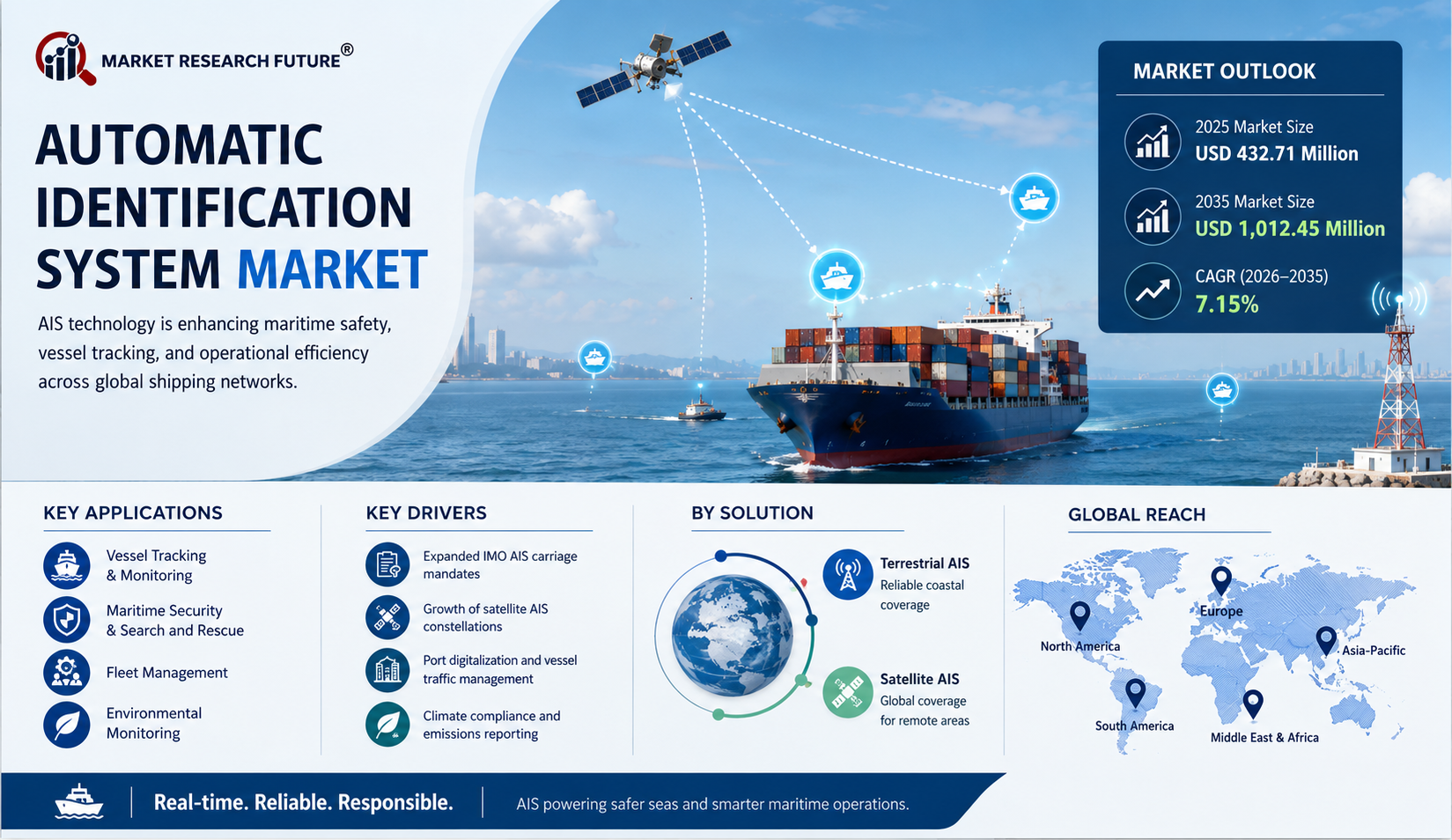
The market is projected to grow from USD 432.71 million in 2025 to USD 1,012.45 million by 2035, registering a CAGR of 7.15% during 2026–2035.
NEW YORK, NY, UNITED STATES, July 23, 2026 /EINPresswire.com/ — The Automatic Identification System (AIS) Market is experiencing steady expansion, supported by the rising importance of maritime safety, digitalization of global shipping networks, and increasing regulatory compliance requirements. AIS technology, which enables vessels to broadcast real-time information such as identity, position, speed, and route, has become a foundational element in modern maritime operations. Governments, port authorities, shipping companies, and defense organizations rely heavily on AIS systems to ensure safe navigation, prevent collisions, and improve operational visibility.
This growth is largely attributed to the expansion of global trade routes, increased vessel traffic, and the integration of AIS with advanced technologies such as satellite communication, big data analytics, and autonomous navigation systems. The market is also benefiting from continuous investments in maritime infrastructure, including smart ports and vessel traffic management systems.
Latest Market Trends:
Adoption of Satellite AIS (Sat-AIS) for Global Coverage – One of the most significant trends in the AIS market is the growing adoption of satellite-based AIS solutions. Traditional terrestrial AIS systems are limited by line-of-sight communication and coastal coverage constraints. Satellite AIS overcomes these limitations by providing global vessel tracking capabilities, including remote oceanic regions and polar routes. This advancement is particularly important for monitoring long-haul shipping, illegal fishing activities, and environmental risks. As satellite constellations expand, data accuracy and refresh rates are improving, making Sat-AIS a preferred solution for global maritime intelligence.
Request Sample of Report: https://www.marketresearchfuture.com/sample_request/10567
Transition Toward VHF Data Exchange System (VDES) – The evolution of AIS technology into the VHF Data Exchange System (VDES) is another key trend shaping the market. VDES enhances communication bandwidth and supports two-way data exchange between vessels and shore stations. This allows for more complex data transmission, including weather updates, route optimization data, and safety alerts. The transition to VDES is gaining momentum as maritime authorities upgrade their infrastructure to accommodate next-generation communication requirements.
Integration with Autonomous Vessel Technologies – The rise of autonomous and remotely operated vessels is driving the integration of AIS with advanced navigation systems. AIS plays a critical role in enabling situational awareness and collision avoidance for autonomous vessels. By combining AIS data with artificial intelligence and sensor technologies, shipping companies can improve navigation efficiency and safety. This trend is particularly evident in technologically advanced regions such as Europe and Asia-Pacific.
Increasing Use of AIS Data for Analytics and Intelligence – AIS data is increasingly being used beyond navigation purposes. Companies are leveraging AIS datasets for supply chain optimization, trade flow analysis, and maritime risk assessment. This trend is transforming AIS from a hardware-centric market into a data-driven ecosystem, where insights derived from AIS data provide significant value to stakeholders across industries.
Market Drivers:
Expansion of IMO AIS Carriage Mandates (~18% Impact) – Regulatory mandates from international organizations are a major driver of market growth. The expansion of AIS carriage requirements to include smaller vessels is significantly increasing the addressable market. This regulatory push ensures that more vessels are equipped with AIS systems, enhancing maritime safety and transparency. The short-term impact of these mandates is expected to be substantial, particularly in regions with high maritime activity.
Growth of Satellite AIS Constellations (~16% Impact) – The deployment of additional satellites is improving global AIS coverage and reducing data latency. Satellite AIS enables continuous monitoring of vessels in remote and previously inaccessible regions. This capability is essential for applications such as maritime security, environmental monitoring, and global trade analysis. The medium-term impact of satellite expansion is expected to drive significant market growth.
Port Digitalization and Vessel Traffic Management (~15% Impact) – The increasing adoption of smart port technologies is driving demand for AIS systems. Ports are integrating AIS with digital traffic management systems to improve vessel coordination, reduce congestion, and enhance operational efficiency. This trend is particularly strong in Asia-Pacific and Europe, where governments are investing heavily in port modernization.
Climate Compliance and Emissions Reporting (~12% Impact) – Environmental regulations are encouraging the use of AIS for monitoring vessel emissions and ensuring compliance with international standards. AIS data is being used to track fuel consumption, route efficiency, and emissions levels. This trend is expected to gain momentum in the long term, particularly in regions with strict environmental policies.
Integration with Maritime Insurance Systems (~10% Impact) – Insurance companies are increasingly using AIS data to assess risks and determine premiums. Real-time vessel tracking provides valuable insights into vessel behavior, route patterns, and operational risks. This integration is improving underwriting accuracy and reducing fraud, thereby driving demand for AIS systems.
Adoption in Autonomous Navigation Systems (~8% Impact) – AIS is becoming a critical component in autonomous vessel navigation. By providing real-time situational awareness, AIS supports safe and efficient autonomous operations. This driver is expected to have a long-term impact as the adoption of autonomous shipping increases.
Expansion of Arctic Shipping Routes (~6% Impact) – The opening of Arctic shipping routes due to climate change is creating new opportunities for AIS deployment. These routes require reliable tracking systems to ensure safety in harsh and remote environments. This trend is particularly relevant in Nordic countries and North America.
Market Opportunities:
Satellite AIS Data Monetization – The growing availability of AIS data presents significant monetization opportunities. Companies are using AIS data to develop analytics platforms that provide insights into shipping patterns, trade flows, and market trends. This shift toward data-driven services is creating new revenue streams and enhancing the overall value proposition of AIS solutions.
VDES Migration and Next-Generation Transponders – The transition to VDES technology offers opportunities for equipment manufacturers to develop advanced transponders and communication systems. These next-generation solutions provide higher data capacity and improved reliability, making them essential for future maritime operations.
Integration with Autonomous Vessels – The development of autonomous vessels is creating new demand for AIS systems that can seamlessly integrate with advanced navigation technologies. This opportunity is expected to drive innovation and investment in the AIS market over the long term.
Recent Developments:
1. March 2025 – Saab AB Contract for VDES Upgrade :- Saab AB secured a significant contract to upgrade coastal AIS infrastructure with VDES-ready hardware. This development highlights the industry’s transition toward next-generation communication systems and reinforces Saab’s leadership in maritime technology.
2. January 2025 – Spire Global Satellite Expansion :- Spire Global expanded its satellite constellation, improving global AIS coverage and data accuracy. This development strengthens the company’s position in the satellite AIS market and enhances its data analytics capabilities.
3. November 2024 – IMO Regulation Update :- The International Maritime Organization introduced new regulations lowering the AIS carriage threshold, significantly increasing the number of vessels required to adopt AIS systems. This development is expected to drive market growth in the coming years.
4. September 2024 – Kongsberg Autonomous Vessel Integration :- Kongsberg partnered with Yara International to integrate AIS systems into an autonomous container vessel. This collaboration demonstrates the growing importance of AIS in autonomous shipping.
5. June 2024 – L3Harris Coast Guard Contract :- L3Harris Technologies secured a contract to modernize AIS infrastructure for the U.S. Coast Guard. This development underscores the importance of AIS in national security and maritime surveillance.
6. January 2024 – EU Emissions Trading System Inclusion :- The inclusion of maritime shipping in the EU ETS is driving demand for AIS-based emissions monitoring solutions. This development is expected to accelerate the adoption of AIS systems in Europe.
Profiles of Top Companies:
1. Saab AB – Saab AB is a prominent player in the Automatic Identification System market, recognized for its advanced maritime surveillance and traffic management solutions. The company offers a comprehensive portfolio of AIS products, including Class A and Class B transponders, base stations, and integrated coastal monitoring systems. Saab has positioned itself as a leader in next-generation maritime communication by actively investing in VDES-enabled infrastructure and smart maritime solutions. Its strong collaboration with government agencies and port authorities enables it to secure large-scale contracts, particularly in Europe and Asia-Pacific. The company’s focus on innovation, cybersecurity, and system integration strengthens its competitive position in both commercial and defense maritime sectors.
2. Furuno Electric Co., Ltd. – Furuno is widely known for its high-quality marine electronics and navigation systems, including reliable AIS transponders and receivers. The company serves a diverse customer base ranging from commercial shipping fleets to fishing and recreational vessels. Furuno’s AIS solutions are valued for their durability, accuracy, and seamless integration with onboard navigation systems such as radar and GPS. The company continues to expand its presence by focusing on product innovation and compliance with international maritime standards. Its strong distribution network and reputation for quality make it a preferred choice in global maritime markets.
3. Kongsberg Gruppen – Kongsberg Gruppen is a leading provider of maritime technology solutions, with a strong focus on automation, digitalization, and autonomous vessel operations. The company integrates AIS technology into its advanced navigation and vessel management systems, enabling real-time data exchange and enhanced situational awareness. Kongsberg’s involvement in autonomous shipping projects highlights its strategic emphasis on future-ready maritime solutions. The company leverages its expertise in sensor integration, data analytics, and system engineering to deliver high-performance AIS-enabled solutions for both commercial and defense applications.
4. Spire Global / exactEarth – Spire Global and exactEarth are key players in the satellite AIS segment, specializing in space-based vessel tracking and maritime data analytics. These companies operate satellite constellations that provide global AIS coverage, enabling real-time monitoring of vessel movements across oceans and remote regions. Their solutions are widely used for applications such as supply chain visibility, maritime security, and environmental monitoring. By focusing on data-driven services, these companies are transforming AIS into a valuable intelligence platform, offering actionable insights to governments, logistics providers, and financial institutions.
5. L3Harris Technologies – L3Harris Technologies is a major provider of communication and surveillance systems, including AIS infrastructure for maritime security and vessel traffic management. The company delivers advanced AIS solutions to defense organizations and coast guards, focusing on enhancing situational awareness and national security. Its expertise in large-scale system integration and modernization projects allows it to support complex maritime operations. L3Harris continues to strengthen its market position through strategic contracts and investments in next-generation communication technologies.
6. ORBCOMM Inc. – ORBCOMM is a global leader in satellite-based IoT and AIS solutions, offering end-to-end asset tracking and monitoring services. The company provides satellite AIS data services that enable real-time visibility of vessel movements, supporting applications such as fleet management, logistics optimization, and maritime compliance. ORBCOMM’s strong focus on innovation and connectivity solutions allows it to serve a wide range of industries beyond maritime, including transportation and heavy equipment. Its scalable platform and global coverage make it a key player in the AIS ecosystem.
7. Japan Radio Co. (JRC) – Japan Radio Co. is a well-established provider of maritime communication and navigation equipment, including AIS transponders, receivers, and integrated bridge systems. The company is known for its technological expertise and strong presence in the Asia-Pacific region. JRC focuses on delivering reliable and compliant AIS solutions that meet international maritime standards. Its continuous investment in research and development ensures that it remains competitive in an evolving market driven by digitalization and automation.
8. Garmin Ltd. – Garmin is a recognized brand in navigation technology, offering AIS solutions primarily for recreational boating and small commercial vessels. The company emphasizes user-friendly design, affordability, and seamless integration with its broader range of marine electronics. Garmin’s AIS products are widely used by individual vessel owners and smaller operators who require efficient and easy-to-use tracking solutions. Its strong brand recognition and global distribution network support its growth in the AIS market.
9. SRT Marine Systems – SRT Marine Systems specializes in AIS-based maritime domain awareness solutions, particularly for government and security agencies. The company provides integrated systems that combine AIS data with advanced analytics to enhance surveillance, fisheries management, and border security. SRT’s solutions are designed to address complex maritime challenges, including illegal fishing and piracy. Its focus on system-level integration and long-term government contracts positions it as a key player in the security segment of the AIS market.
10. SAAB / Consilium – The collaboration between SAAB and Consilium focuses on delivering integrated maritime safety and monitoring solutions. By combining AIS technology with fire safety and alarm systems, the partnership provides comprehensive solutions for vessel safety and operational efficiency. This integrated approach allows the companies to address multiple aspects of maritime risk management, making them valuable partners for shipping companies and offshore operators.
Regional Analysis:
Asia-Pacific – Asia-Pacific holds the largest market share, driven by extensive maritime trade and significant investments in port infrastructure. Countries in this region are adopting AIS systems to enhance operational efficiency and safety.
Europe – Europe is a mature market characterized by strict environmental regulations and advanced digitalization initiatives. The integration of AIS with emissions monitoring systems is a key growth driver.
North America – North America is witnessing steady growth due to investments in maritime infrastructure and expansion of AIS coverage in Arctic regions.
South America – The market in South America is growing due to modernization of naval systems and increased regulatory requirements for fishing fleets.
Middle East & Africa – This region is experiencing growth driven by port digitalization and the need for enhanced maritime security.
Segment Analysis:
1. By Application – The vessel tracking and monitoring segment dominates the market, as AIS is essential for navigation and safety. Maritime security and search and rescue applications are also significant, supported by increasing security concerns. Fleet management and environmental monitoring are emerging as important segments due to the growing focus on efficiency and sustainability.
2. By Platform – Vessel-based AIS transponders account for the largest share, as they are mandatory for many vessels. On-shore-based stations play a crucial role in coastal monitoring and traffic management.
3. By Component/Class – Class A transponders are widely used in large commercial vessels, while Class B transponders are suitable for smaller vessels. AIS base stations and receivers are essential for data collection and communication.
4. By Solution – Terrestrial AIS is widely used for coastal applications, while satellite AIS is gaining popularity for global coverage and advanced analytics.
Conclusion:
The Automatic Identification System Market is set for robust growth, driven by regulatory mandates, technological advancements, and expanding applications. The shift toward satellite-based solutions, integration with autonomous systems, and increasing use of data analytics are transforming the market landscape. As maritime industries continue to embrace digital transformation, AIS will remain a critical component in ensuring safety, efficiency, and sustainability.
Browse More Reports:
Drone Identification Market
https://www.marketresearchfuture.com/reports/drone-identification-market-28945
Air Defense System Market
https://www.marketresearchfuture.com/reports/air-defense-system-market-14006
Drone Flight Controller System Market
https://www.marketresearchfuture.com/reports/drone-flight-controller-system-market-31521
Sagar Kadam
Market Research Future
+ +1 628-258-0071
sales@marketresearchfuture.com
Legal Disclaimer:
EIN Presswire provides this news content “as is” without warranty of any kind. We do not accept any responsibility or liability
for the accuracy, content, images, videos, licenses, completeness, legality, or reliability of the information contained in this
article. If you have any complaints or copyright issues related to this article, kindly contact the author above.

Media gallery