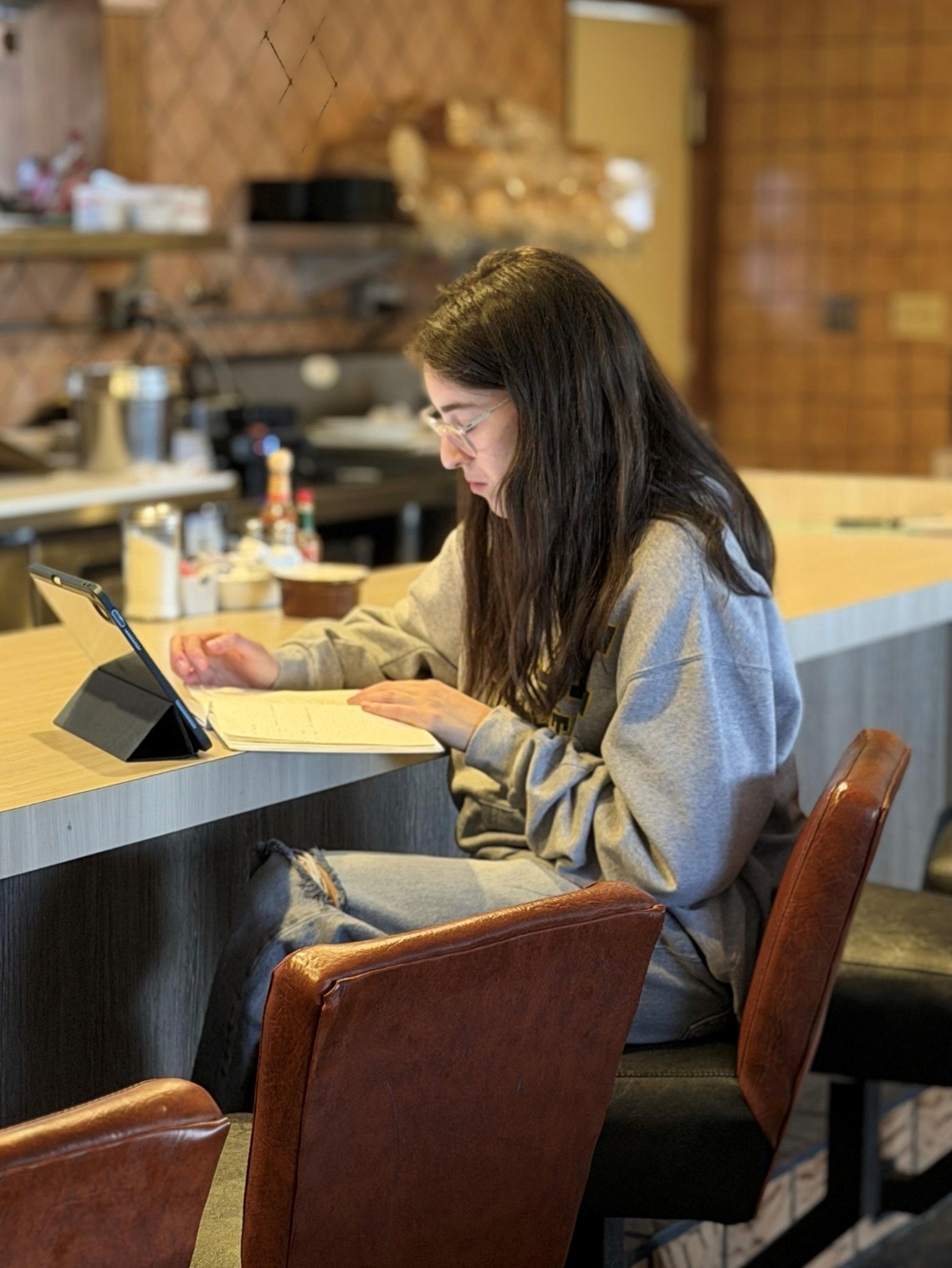
Italian production designer Francesca Porcelluzzi takes on the ambitious Los Angeles-set feature film RONA
LOS ANGELES, CA, UNITED STATES, August 26, 2026 /EINPresswire.com/ — As Francesca Porcelluzzi‘s body of work continues to grow, so too does the scale of the worlds she is being asked to create. The Italian production designer has spent the past several years developing an increasingly diverse portfolio in Los Angeles, moving between period drama, contemporary features, culturally specific narratives, and psychological thrillers. Now, she is preparing to take that versatility into “RONA”, an upcoming psychological crime thriller that will give her the opportunity to design multiple environments across a feature-length story.
Originally from Italy, Porcelluzzi holds a master’s degree in film and media production from the New York Film Academy and a master’s degree in television, cinema, and new media from IULM University in Milan. Her international education has helped shape an approach to filmmaking that combines an appreciation for character-driven storytelling with the practical demands of working on production.
Her recent credits include the feature “She Reminds Me of You” and the short films “Magnolia Daughters”, “The Stolen Mind”, “Half Life”, “10:52”, and “The Last Coin”. Across those projects, Porcelluzzi has demonstrated an ability to adapt her design process to dramatically different stories.
For the 1970s-set “Magnolia Daughters”, she researched period interiors and found inventive ways to transform contemporary spaces into believable environments from another decade. On “10:52”, she undertook detailed cultural research to transform an American home into a Kurdish household. “She Reminds Me of You” required her to create contrasting spaces that reflected the emotional states of characters dealing with grief and healing, while psychological thriller “The Stolen Mind” presented almost the opposite challenge: finding ways to use production design to sustain tension within the extremely confined environment of a car.
That range is particularly relevant as Porcelluzzi prepares for “RONA”. The psychological crime thriller centers on Officer Diaz, a police officer who begins investigating a series of missing-person cases after recognizing a disturbing pattern of abandoned vehicles across Los Angeles. Her investigation eventually leads to criminal psychology professor Dr. Ajax and his daughter, Rona, whose troubled history and complicated relationship with her father conceal something considerably darker.
For Porcelluzzi, the feature presents an opportunity to build a more expansive visual world while maintaining the attention to character and detail that has defined her previous work.
“One of the things I’m most excited about from a production design perspective is the variety of locations and environments throughout the film,” she says. “Because it’s a feature, I’ll have the opportunity to create several different spaces, from more grounded, everyday locations to much darker and more unsettling environments as the story develops.”
The progression gives Porcelluzzi an opportunity to use the environments themselves to help track the increasingly disturbing direction of the narrative.
“I’m especially excited about finding ways to make all of these locations feel like they belong to the same world while still giving each one its own identity and atmosphere,” she explains.
It’s a deceptively complex challenge. A feature such as “RONA” requires individual environments to be distinctive enough to communicate character, function, and mood while still sharing a visual language that makes the film feel cohesive. As the investigation moves Officer Diaz deeper into the story, Porcelluzzi will be able to explore how shifts in location, texture, color, props, and set dressing can subtly contribute to the escalating psychological tension.
For a designer who describes production design as “visual storytelling,” that opportunity is significant.
“Every color, object, texture, and location can help tell part of the story without using words,” Porcelluzzi has said of her approach. “When visual storytelling is done well, the audience can understand something about a character or a situation simply by looking at the environment around them.”
Porcelluzzi’s involvement with “RONA” also tells another story about her developing career, one that has less to do with what appears on screen and more to do with what happens behind the camera. She first met director Apoorva Choudhary while working together on another feature film. Choudhary was serving as First Assistant Director, while Porcelluzzi headed production design.
The production presented its share of challenges, including a last-minute location change that required the team to adapt quickly. For a production designer, a sudden location change can have significant consequences. A design developed around one space may need to be reconsidered rapidly, with set dressing, props, continuity, logistics, and the visual requirements of the story all potentially affected. It was precisely how Porcelluzzi responded to that pressure that helped lead to her next opportunity.
“We worked really well together, especially when it came to handling the challenges that came up during production, including a last-minute location change,” Porcelluzzi recalls. “She appreciated my dedication and the way I handled those situations, and after that experience, she reached out because she wanted to work together again on RONA.”
The invitation speaks to an important part of filmmaking that audiences rarely see. A production designer’s value extends beyond artistic ability. Film production demands creative professionals who can communicate across departments, respond when circumstances change, protect the visual integrity of the project, and find workable solutions without losing sight of the director’s vision. Porcelluzzi considers that balance between creativity and practicality one of her strengths.
“I enjoy finding visual solutions that support the story while also working within the realities of a production, whether that means limited budgets, tight schedules, or challenging locations,” she says.
Those qualities are particularly important on independent productions, where unforeseen circumstances can require departments to make significant adjustments quickly. Being invited onto another feature by a filmmaker who has already witnessed her work firsthand represents an important vote of professional confidence. It also reflects Porcelluzzi’s broader belief that filmmaking is fundamentally collaborative.
Having studied and worked across Italy and the United States, she has developed an international perspective on that process. Fluent in English, Italian, and Spanish, with conversational French, she has gravitated toward filmmakers and stories exploring different cultures, identities, relationships, and experiences. No matter the genre, however, she begins with character. Before selecting furniture or sourcing props, Porcelluzzi considers who inhabits a space, how they live, what objects they would surround themselves with, and what their environment can communicate to an audience.
That character-first approach should provide fertile creative territory in “RONA”, particularly within the world surrounding Dr. Ajax and his daughter. With a narrative built around criminal psychology, fractured relationships, hidden histories, and an investigation into increasingly sinister events, the physical spaces have the potential to reveal information even when the characters do not. Unlike the single-environment challenge of “The Stolen Mind”, “RONA” will allow Porcelluzzi to work on a considerably broader canvas. From everyday Los Angeles locations to the darker spaces Officer Diaz encounters as her investigation progresses, each environment presents another opportunity to influence how the audience experiences the mystery.
The project therefore marks a natural next step in Porcelluzzi’s development as a production designer. Her previous work has required historical research, cultural sensitivity, emotional storytelling, creative problem-solving, and an ability to achieve visual impact within significant physical limitations. “RONA” brings many of those skills together within the larger framework of a psychological crime feature.
Perhaps just as importantly, it represents the kind of professional progression that happens when strong work leads to another call. In an industry built on collaboration, trust, and the ability to deliver under pressure, repeat creative partnerships can be as meaningful as the credits themselves. Porcelluzzi’s move onto RONA demonstrates that her contribution is being recognized not only through the worlds she creates on screen, but through the relationships she builds behind it.
As she prepares to design the film’s increasingly dark visual landscape, Francesca Porcelluzzi enters “RONA” as more than the person responsible for how its locations look. She is part of the creative team responsible for defining how its world feels, and, in a psychological thriller where appearances may conceal something far more sinister, that distinction could make all the difference.
“RONA” is currently in pre-production and is set to film in Los Angeles in 2026. Further production and release information will be announced as the project moves forward. For more information on Francesca Porcelluzzi visit: Instagram or her IMDb.
Liz Rodriguez
EMR Media
+1 310-435-3634
email us here
Legal Disclaimer:
EIN Presswire provides this news content “as is” without warranty of any kind. We do not accept any responsibility or liability
for the accuracy, content, images, videos, licenses, completeness, legality, or reliability of the information contained in this
article. If you have any complaints or copyright issues related to this article, kindly contact the author above.

Media gallery