The 100–200 kW power band accounted for USD 3.11 billion in 2025, serving the dominant passenger-car segment.
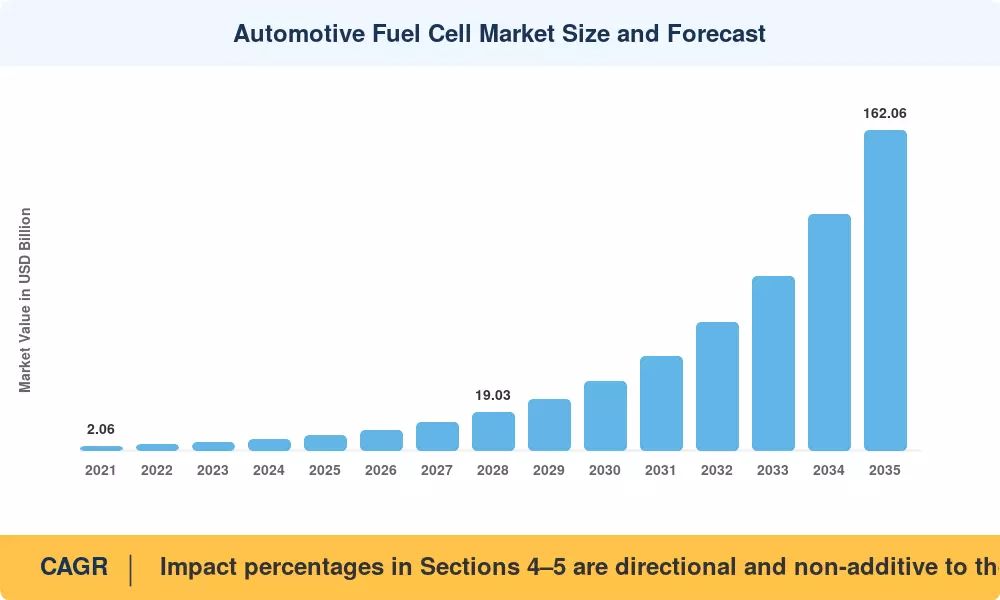
NEW YORK, NY, UNITED STATES, August 26, 2026 /EINPresswire.com/ — According to Market Research Future, the Automotive Fuel Cell Market is projected to climb from USD 10.32 billion in 2026 to USD 162.06 billion by 2035, registering a CAGR of 35.8% across the forecast 2026 to 2035, driven by growing demand for zero-emission vehicles drives innovation. This extraordinary growth trajectory underscores the pivotal role that hydrogen fuel cell technology is poised to play in the global transportation sector’s decarbonization efforts. The market’s explosive expansion reflects the convergence of supportive government policies, accelerating infrastructure development, and significant technological advancements that are making fuel cell electric vehicles increasingly viable for both passenger and commercial applications.
Market Overview
Automotive fuel cells are electrochemical devices that convert the chemical energy of hydrogen and oxygen into electricity, producing only water vapor and heat as byproducts. This zero-emission technology offers a compelling alternative to battery electric vehicles, particularly for applications requiring long driving ranges, rapid refueling, and heavy-duty performance. Fuel cell electric vehicles combine the environmental benefits of electric propulsion with the convenience and operational characteristics of conventional internal combustion engine vehicles, making them uniquely suited for commercial transportation, logistics, and passenger vehicles where range anxiety and charging time remain concerns.
The key growth drivers propelling this market forward include the growing demand for zero-emission vehicles drives innovation across the automotive industry. Government policies and regulatory frameworks worldwide are establishing ambitious targets for hydrogen adoption and zero-emission vehicle deployment, creating a favorable environment for fuel cell technology investment . National hydrogen strategies in countries across Asia Pacific, Europe, and North America are providing clear targets and funding for development, accelerating market growth . The expansion of hydrogen refueling infrastructure is another critical driver, as governments and private companies invest heavily in hydrogen refueling networks, particularly in regions with high potential for fuel cell vehicle deployment such as California, Germany, and Japan .
Policy and regulatory frameworks are playing a transformative role in market development. Governments worldwide are implementing comprehensive hydrogen strategies, with the UAE’s National Hydrogen Strategy 2050 targeting production of 1.4 mtpa by 2031 and 15 mtpa by 2050 . The European Union’s stringent emission regulations and commitment to reducing carbon emissions are accelerating the adoption of fuel cell technology across all vehicle segments. Government incentives, tax credits, subsidies, and grants for hydrogen fuel cell vehicle adoption are creating a favorable economic environment for market growth .
📍 Get Free Sample Report for Detailed Market Insights: https://www.marketresearchfuture.com/sample_request/5932
Market Segmentation
The automotive fuel cell market is segmented based on vehicle type, drive type, power output, propulsion, and regional analysis to provide comprehensive insights into industry dynamics.
By Vehicle Type: The market is categorized into Passenger Cars, Light Commercial Vehicles, Medium and Heavy Commercial Vehicles, and Buses and Coaches. Passenger vehicles dominate the market, accounting for a significant share driven by government targets to promote fuel cell electric vehicles and extensive services offered by automakers . The growing consumer interest in zero-emission mobility solutions and the availability of models such as the Toyota Mirai, Honda Clarity, and Hyundai Nexo are driving demand in this segment . Light Commercial Vehicles represent a growing segment as commercial infrastructure and companies increasingly utilize hydrogen-powered automotive for regular operations . Medium and Heavy Commercial Vehicles represent a substantial opportunity, as fuel cell technology is particularly well-suited for heavy-duty applications where battery weight and charging limitations pose challenges . Buses and Coaches are gaining traction in public transit applications, with fuel cell buses offering zero-emission solutions for urban transport where high uptime and extended range are critical . The Hydrogen Fuel Cell Vehicle Market provides additional context on vehicle-specific adoption trends and growth trajectories.
By Drive Type: The market is segmented into Front-Wheel Drive, Rear-Wheel Drive, and All-Wheel Drive configurations. Front-wheel drive and all-wheel drive configurations are prevalent in passenger vehicle applications, while rear-wheel drive and all-wheel drive configurations are common in commercial and heavy-duty vehicles where traction and power delivery requirements differ.
By Power Output: The market is divided into Below 100 kW, 100 to 200 kW, and Above 200 kW segments. The Below 100 kW power rating segment is expected to lead the market, driven by the rising adoption of fuel cell passenger vehicles and the development of advanced automobiles with lower manufacturing costs . The 100 to 200 kW power stacks are projected to exhibit considerable growth, driven by expanding public transit infrastructure and replacement of existing fleets with fuel cell alternatives . The Above 200 kW segment is set to experience growing demand as research and development activities focus on integrating fuel cell systems in heavy and ultra-heavy applications . The Automotive Fuel Cell Market serves as the primary reference for comprehensive market analysis across all power output segments.
By Propulsion: The market is categorized into Fuel Cell Electric Vehicle and Hybrid Fuel Cell configurations. Fuel Cell Electric Vehicles represent the primary propulsion type, utilizing fuel cells as the sole power source for the electric motor. Hybrid Fuel Cell configurations combine fuel cells with battery or supercapacitor systems to optimize power delivery and energy recovery, offering advantages in acceleration response and system efficiency.
By Region: The market covers North America, Europe, South America, Asia Pacific, and the Middle East and Africa. Asia Pacific dominates the global market, driven by rising national hydrogen roadmaps in countries like Japan, South Korea, and China, providing clear targets and funding for development . North America and Europe follow as significant markets with increasing investment in hydrogen infrastructure and growing adoption of fuel cell vehicles across all segments.
🛒 You can buy this market report at: https://www.marketresearchfuture.com/checkout?currency=one_user-USD&report_id=5932
Regional Analysis
Asia Pacific dominates the global automotive fuel cell market, representing a significant share driven by rising national hydrogen roadmaps in countries like Japan, South Korea, and China providing clear targets and funding for development . Favorable government-led public transport initiatives integrating hydrogen buses and taxis into urban mobility systems are driving market growth across the region . China launched over 60 new green hydrogen projects between January and November 2023, with investments totaling more than RMB 410 billion, demonstrating the country’s aggressive commitment to hydrogen technology development . Japan and South Korea continue to invest heavily in hydrogen technology, boosting demand for automotive fuel cell systems. The region’s increasing investment in domestic green hydrogen production reinforces supply chain security and aligns with net-zero goals . Strategic alliances between automakers and fuel cell system developers are fast-tracking commercialization of next-generation fuel cell electric vehicles, expanding market scope . Increasing deployment of hydrogen-powered logistics and cargo handling vehicles in port cities is reducing emissions in high-traffic zones and fueling market expansion . Asia Pacific is poised to become the dominant growth engine for the global fuel cell vehicle market as infrastructure deployment accelerates and production scales up .
North America represents a significant and rapidly growing market, with strict emission regulations, technology manufacturers, and tax credits expanding the fuel cell market . The United States leads the region with increasing alignment between federal clean energy policies and private-sector investment strategies . State-level initiatives are accelerating hydrogen corridor development to support long-distance fuel cell vehicle operation . Public transit authorities are prioritizing hydrogen fuel cell buses for routes requiring high uptime and extended range, while commercial fleet operators are testing hydrogen-powered trucks to reduce emissions without compromising payload capacity . Top automakers and OEMs in the U.S. are boosting fuel-cell commercial vehicle adoption, with Hyundai planning to build a USD 6.4 billion factory to produce 500,000 fuel cell systems by 2030 . Research and development activity in fuel cell stack efficiency continues to strengthen regional competitiveness, with automakers collaborating with energy companies to secure long-term hydrogen supply .
Europe represents a technologically sophisticated market with strong growth projections driven by stringent emission regulations, increasing investment in hydrogen infrastructure, and government support for clean energy initiatives. The European Union’s commitment to reducing carbon emissions and promoting alternative fuels is accelerating fuel cell vehicle adoption across all segments. Fuel cell electric buses represent a primary application for fuel cell systems in domestic and international markets, with the JIVE program expected to drive adoption across the region . Germany leads the European market, with Robert Bosch GmbH accelerating its massive €2.5 billion hydrogen technology investment strategy, optimizing automated assembly lines to mass-produce proton-exchange membrane fuel cell power modules for key heavy-duty transport buyers . The region’s strong automotive manufacturing base and focus on decarbonization continue to support fuel cell market expansion.
South America and the Middle East and Africa represent emerging markets with significant growth potential. South America is gaining momentum through a combination of regional energy initiatives and strategic investments, with rapid integration of hydrogen into national energy transition plans prioritizing its role in decarbonizing heavy transport . Brazil approved the first phase of Fortescue’s USD 3.6 billion green hydrogen project in Ceará, positioning the region as a future green hydrogen export hub . The Middle East and Africa are experiencing growth influenced by increasing national hydrogen strategies focused on economic diversification and decarbonization, with the UAE targeting production of 1.4 mtpa of hydrogen by 2031 . Growing investment in green hydrogen production and export capabilities in Saudi Arabia and the UAE is driving demand for fuel cell electric vehicle compatible infrastructure .
Competitive Landscape and Key Players
The automotive fuel cell market is characterized by intense competition among established automotive manufacturers, specialized fuel cell technology providers, and emerging innovators. Key players are focusing on technological innovation, strategic partnerships, and geographic expansion to strengthen their market positions . Automakers are investing heavily in research and development to enhance fuel cell technology, improve vehicle performance, and reduce production costs . Collaboration between automakers, energy providers, and technology firms is common, as partnerships help accelerate the development of both vehicles and the necessary fueling infrastructure .
Major companies operating in this space include Toyota Motor Corporation, Hyundai Motor Company, Honda Motor Co., Ltd., BMW AG, Mercedes-Benz Group AG, General Motors Company, Ford Motor Company, Volvo Group, Daimler Truck Holding AG, Nikola Corporation, Ballard Power Systems Inc., Plug Power Inc., Cummins Inc., Robert Bosch GmbH, Symbio, Hyundai Mobis Co., Ltd., and Quantum Fuel Systems LLC . These industry leaders are pursuing diverse strategies including vertical integration, technology licensing, and strategic partnerships to capture market share in the rapidly evolving fuel cell ecosystem.
Strategic developments are reshaping the competitive landscape . In February 2026, Robert Bosch GmbH accelerated its massive €2.5 billion hydrogen technology investment strategy, optimizing automated assembly lines to mass-produce proton-exchange membrane fuel cell power modules for key heavy-duty transport buyers . In January 2026, Honda continued expanding its commercial reach in California’s logistics and consumer corridors, using its newly deployed CR-V e:FCEV framework to bridge battery-electric capabilities with a hydrogen fuel cell backup powertrain . In July 2025, Hyundai Mobis Co., Ltd. and Quantum Fuel Systems LLC modernized their component lines to produce advanced electronic controllers and high-capacity metallic hydride tanks, aiming to significantly reduce the overall total cost of ownership for fuel cell fleets .
Latest Industry News and Developments
Recent industry developments highlight the dynamic evolution of the automotive fuel cell market and the intensifying competition among major players. In February 2026, Robert Bosch GmbH accelerated its massive €2.5 billion hydrogen technology investment strategy, optimizing automated assembly lines to mass-produce proton-exchange membrane fuel cell power modules for key heavy-duty transport buyers .
In January 2026, Honda continued expanding its commercial reach in California’s logistics and consumer corridors, using its newly deployed CR-V e:FCEV framework to bridge battery-electric capabilities with a hydrogen fuel cell backup powertrain .
In July 2025, Hyundai Mobis Co., Ltd. and Quantum Fuel Systems LLC modernized their component lines to produce advanced electronic controllers and high-capacity metallic hydride tanks, aiming to significantly reduce the overall total cost of ownership for fuel cell fleets .
In December 2023, General Motors and Komatsu announced they would co-develop a hydrogen fuel cell power module for Komatsu’s 930E electric drive mining truck, the world’s best-selling ultra-class haul truck, demonstrating the expanding applications for fuel cell technology beyond on-road vehicles .
Market Challenges and Opportunities
The automotive fuel cell market faces several significant challenges that require strategic solutions for sustainable growth. High manufacturing costs associated with fuel cell vehicles remain a primary barrier to mass adoption, limiting their competitiveness with conventional and battery electric vehicles . The lack of hydrogen refueling infrastructure has historically been a barrier to widespread adoption of fuel cell vehicles, though governments and private companies are now investing heavily in hydrogen refueling networks . Hydrogen fuel cells are also subject to safety concerns, as they are prone to fire when exposed to fire, which is a major consideration for vehicle design and infrastructure development . Supply chain complexity and trade policy shifts create additional operational challenges for manufacturers .
Emerging opportunities in the market are substantial and growing. The expansion of hydrogen refueling infrastructure is a crucial factor driving adoption, as the availability of refueling stations improves the convenience and practicality of owning a hydrogen fuel cell vehicle, driving consumer and fleet adoption . The rise of renewable energy and the push for green hydrogen production is further fueling the market, as green hydrogen offers a truly zero-emission fuel for hydrogen vehicles . As the costs of renewable energy continue to fall and electrolyzer technologies improve, the production of green hydrogen is becoming more economically viable .
Technology-driven possibilities are expanding rapidly across the industry. Improvements in fuel cell efficiency, durability, and cost reduction have made hydrogen fuel cell vehicles more competitive with traditional vehicles and battery electric vehicles . Technological advancements in hydrogen storage and refueling are bridging infrastructure gaps and augmenting fuel cell electric vehicle viability for commercial and consumer use . The integration of artificial intelligence and machine learning into fuel cell system management enables predictive maintenance, optimized performance, and enhanced reliability. Modular system architectures enable reuse of common subcomponents across power ranges and vehicle classes, accelerating time-to-market and reducing variant-specific development costs .
To explore more market insights, visit us at: https://www.marketresearchfuture.com/reports/automotive-fuel-cell-market-5932
Final Market Summary
Key factors expected to influence future development include the pace of hydrogen infrastructure deployment, technological advances in fuel cell efficiency and durability, regulatory frameworks promoting zero-emission vehicles, and the evolving competitive landscape shaped by strategic partnerships and capacity expansion. The ability to create high-energy cells that can power cars through automotive fuel cell technology remains attractive to automakers, driving continued investment and innovation in this transformative technology . T
More Related Reports from MRFR Library:
Automotive Cabin Air Filter Market : https://www.marketresearchfuture.com/reports/automotive-cabin-air-filter-market-23431
Dump Trailer Market : https://www.marketresearchfuture.com/reports/dump-trailer-market-23438
Automotive Bracket Market : https://www.marketresearchfuture.com/reports/automotive-bracket-market-23443
Automotive Bicycle Rack Market : https://www.marketresearchfuture.com/reports/automotive-bicycle-rack-market-23447
Automotive Digital Mirror Market : https://www.marketresearchfuture.com/reports/automotive-digital-mirror-market-23563
Hot and Cold Water Dispensers Market : https://www.marketresearchfuture.com/reports/hot-cold-water-dispensers-market-23574
In Vehicle Apps Market : https://www.marketresearchfuture.com/reports/in-vehicle-apps-market-23613
Automotive Led Headlamps Market : https://www.marketresearchfuture.com/reports/automotive-led-headlamps-market-23725
Automotive 48V System Market : https://www.marketresearchfuture.com/reports/automotive-48v-system-market-24066
Autonomous Cars Software Market : https://www.marketresearchfuture.com/reports/autonomous-cars-software-market-24308
Market Research Future
Market Research Future
+1 855-661-4441
email us here
Legal Disclaimer:
EIN Presswire provides this news content “as is” without warranty of any kind. We do not accept any responsibility or liability
for the accuracy, content, images, videos, licenses, completeness, legality, or reliability of the information contained in this
article. If you have any complaints or copyright issues related to this article, kindly contact the author above.

Media gallery