
The next major shift in retail may not be happening on shelves. It is happening in the everyday grocery basket, where speed, convenience and top-up missions are reshaping how consumers buy. Quick commerce is emerging as a core engine of grocery growth, according to NIQ (NYSE: NIQ), a leading consumer intelligence company.
This press release features multimedia. View the full release here: https://www.businesswire.com/news/home/20260824560517/en/
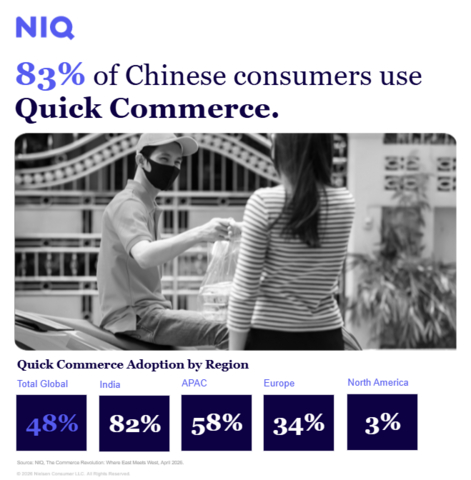
Asia is leading the quick commerce revolution, with adoption rates of 83% in China and 82% in India.
NIQ’s global report, The Commerce Revolution: Where East Meets West, finds that ultra-fast delivery is already mainstream across parts of Asia, offering a preview of how commerce is likely to evolve globally.
The clearest signs of this shift can be seen in China and India, where quick commerce adoption has reached 83% and 82%, respectively, far exceeding the global average of 48%. By comparison, adoption stands at 34% in Europe and just 3% in North America, highlighting the different stages of market maturity and the growing gap in consumer expectations around speed and convenience.
The must-know signals
- Quick commerce is mainstream in China: 83% of surveyed consumers use the channel, with the market expected to exceed one trillion yuan this year.
- Fulfillment at massive scale: China processed 199 billion parcels in 2025, up nearly 14% year over year, underscoring the infrastructure behind rapid delivery.
- India is a key growth engine: Quick commerce grew 68% year over year in Q4 2025, supported by a dark-store network projected to exceed 5,000 locations, with up to 1,800 transactions per store per day.
- Grocery missions are expanding: In India, quick commerce is moving beyond top-up shopping into fuller basket missions, with rising repeat purchase and larger order sizes.
- Channel growth ≠ brand performance: Across social commerce, where brands allocate 27.4% of spend on average, 58% still report ROI below $1—highlighting the gap between participation and profitability.
The data points to a broader shift: commerce is no longer evolving in silos. Discovery, transaction, and fulfillment are converging into a single, integrated system-one increasingly shaped by AI, platforms, and real-time consumer needs.
“China and India are showing what happens when convenience becomes an expectation rather than a differentiator. The question for brands is no longer whether to participate in quick commerce, but how to do so profitably. Growth is accelerating, but sustainable value will come from understanding which consumer missions truly benefit from immediacy,” said Emilie Darolles, President Western Europe, NielsenIQ.
The broader message of the report is clear: commerce is no longer evolving in isolated channels: it is converging into a single system where discovery, transaction, and fulfillment move together. For manufacturers and retailers, the next wave of growth will not come from adding channels, but from orchestrating the system—aligning assortment, pricing, visibility, and fulfillment with how consumers actually shop.
About the report
The Commerce Revolution: Where East Meets West analyzes the convergence of Eastern and Western commerce models across live commerce, social commerce, quick commerce, retail media networks, and emerging agentic commerce. It draws on NIQ Consumer Outlook, Retail Pulse, Digital Purchases, and Omnisales data, alongside third-party sources including McKinsey, Morgan Stanley, and Adobe.
About NIQ
NielsenIQ (NYSE: NIQ) is a leading consumer intelligence company, delivering the most complete and trusted understanding of consumer buying behavior and revealing new pathways to growth. By combining an unmatched global data footprint and granular consumer and retail measurement with decades of AI modeling expertise, NIQ builds decision systems that help companies turn complex data into confident action. With operations in more than 90 countries, NIQ covers approximately 82% of the world’s population and more than $7.4 trillion in global consumer spend. Through cloud-based platforms, advanced analytics and AI-driven insights, NIQ delivers The Full View™ — helping brands and retailers understand what consumers buy, why they buy it, and what to do next. For more information, please visit www.niq.com.
Forward-Looking Statements
This press release, regarding NIQ’s The Commerce Revolution: Where East Meets West report and trends in quick commerce and related channels, contains forward-looking statements regarding anticipated consumer behaviors, market adoption and growth, channel development, fulfillment capacity, and potential impacts on brands and retailers. These statements reflect current expectations, estimates, and projections based on available data, historical patterns, third-party information, and assumptions that may prove incorrect. Words such as “indicates,” “expects,” “anticipates,” “projects,” “likely,” “may,” and similar expressions are intended to identify forward-looking statements. These statements are not guarantees of future outcomes and are subject to inherent uncertainties, including changes in consumer preferences, economic conditions, technological advancements, and competitive dynamics. Actual results may differ materially from those expressed or implied in these statements. While we strive to base our insights on reliable data and sound methodologies, we undertake no obligation to update any forward-looking statement, except as required by law.
Notes to editors
Figures in this release are drawn from NielsenIQ’s The Commerce Revolution: Where East Meets West and include both NIQ proprietary data and third-party market figures cited in the report. The quick-commerce penetration, consumer-adoption, and category-use figures are based on NIQ Consumer Outlook, Retail Pulse, and Digital Purchases data. Market-scale and parcel-volume figures for China, including the over one trillion yuan market estimate and 199 billion parcels in 2025, are cited in the report from market sources (Adobe, Morgan Stanley, Joybuy). The social-commerce spend and ROI figures are based on NIQ social media norms cited in the report.
Frequently asked questions
What is the single biggest finding?
Quick commerce is no longer an emerging behavior in parts of Asia. In China, it has reached 83% consumer penetration and is expected to exceed one trillion yuan in market value this year.
Why does this matter for brands and retailers?
Because quick commerce is changing how consumers shop for everyday needs — especially top-up and grocery missions — and forcing brands to rethink assortment, availability, and fulfillment around real consumption occasions.
Is this just another “growth at all costs” commerce story?
No. The report’s reality check is that channel scale does not guarantee healthy returns. Social commerce already attracts 27.4% of average brand spend, yet 58% of brands still generate less than $1 ROI.
What should brands do now?
Design products, promotions, and fulfillment strategies around specific consumer need states and localized logistics, while measuring where quick commerce creates incremental value rather than simply shifting spend across channels.
NIQ-GENERAL
View source version on businesswire.com: https://www.businesswire.com/news/home/20260824560517/en/
Media gallery


