
CHICAGO, IL / ACCESS Newswire / September 3, 2026 / Global financial giants are quietly committing massive capital to build out digital asset infrastructure, shifting their strategy from treating cryptocurrency as a speculative investment to establishing blockchain as the foundational layer of global finance.
Despite a stalled legislative landscape in Washington – including the stalled CLARITY Act1 – institutions like BlackRock, JPMorgan Chase, and BNY Mellon are building custody platforms, tokenization engines, and settlement networks to update centuries-old financial systems. For investors, navigating this seismic structural shift requires moving past self-directed speculation and engaging with modern wealth management professionals equipped to harness these institutional-grade tools.
THE PIVOT FROM SPECULATION TO INFRASTRUCTURE
Rather than trying to replace the existing global economy, major financial institutions are actively embedding blockchain into traditional operations. Wall Street is prioritizing two primary technological vectors to modernize market operations:
-
Tokenization: Converting traditional vehicles like stocks, bonds, and real estate into digital tokens to slash settlement delays and unlock the fractional ownership of high-value assets.
-
Stablecoins: Utilizing digitized fiat currencies to frictionlessly move liquidity across cross-border blockchain protocols.
“We spend so much time talking about AI, we’re not spending enough time talking about how quickly we’re going to tokenize every financial asset.” – Larry Fink, CEO of BlackRock2
The structural demand for these secure, automated tokenized ledgers is being fundamentally accelerated by the rapid rise of artificial intelligence. As autonomous AI agents begin executing complex business workflows, managing budgets, and procuring resources independently, they require an entirely machine-native infrastructure to operate.
Traditional banking systems, bound by manual checks and multi-day settlement delays, cannot support the speed or frequency of machine-to-machine activity. This technological friction is catalyzing the emergence of an unprecedented agentic economy, where programmable tokenized ledgers and stablecoin rails are uniquely positioned to serve as the compliance-friendly financial layer allowing AI agents to securely settle transactions instantly on-chain.
WHY PROFESSIONAL GUIDANCE IS ESSENTIAL IN REGULATORY CATCH-UP
As the private sector accelerates building, government watchdogs are rushing to draft rules for an ecosystem already in flight. Both the Securities and Exchange Commission (SEC) and the Commodity Futures Trading Commission (CFTC) are attempting to carve out frameworks that balance systemic financial stability with necessary market innovation.
Regulatory rhetoric is shifting to match Wall Street’s momentum. SEC leadership has signaled a policy pivot away from enforcement-led crackdowns toward tailored guidelines, explicitly aiming to allow regulated financial firms to transparently experiment on-chain.
However, Wall Street’s aggressive capital deployment proves institutional players are no longer waiting on Washington. For individual investors, this creates a complex paradigm: institutional infrastructure is advancing rapidly, but navigating the evolving tax, legal, and compliance landscapes without professional oversight introduces significant downside risk. Partnering with an active, forward-thinking advisor ensures your portfolio captures these institutional innovations while maintaining strict adherence to regulatory compliance and risk management.
THE ADVISORY EVOLUTION: WHY YOU NEED AN ADAPTIVE FINANCIAL ADVISOR
This rapid structural migration is fundamentally disrupting the wealth management ecosystem, highlighting a growing divide between legacy wealth managers and adaptive, forward-thinking advisors. Historically, traditional advisory firms approached the digital asset conversation through a narrow, reactionary lens: either completely ignoring the asset class due to compliance limitations, or treating it as a volatile, speculative sandbox restricted to spot cryptocurrency allocations.
In our view, that defensive posture is not adapting to the current transformation. As blockchain architecture integrates directly into mainstream financial products, we believe an advisor who is actively adapting to these advances can provide essential strategic advantages:
-
Macro Infrastructure Equities: Rather than forcing clients to absorb the extreme drawdowns of individual digital tokens, an adaptive advisor identifies sophisticated equity strategies. By allocating capital to the market providers actually building the network architecture – such as custody service providers, enterprise software protocols, specialized cybersecurity firms, and data-center real estate trusts – your advisor builds broad exposure to sector growth while mitigating single-asset volatility.
-
Operational Efficiency and Execution: Modern wealth managers leverage modern ledger infrastructure to drastically streamline administrative hurdles. Moving traditional asset transfers, settlement times, and clearing operations on-chain significantly compresses client onboarding timelines, minimizes middle-office errors, and improves execution efficiency for your overall financial plan.
-
Strategic Tax Optimization and Estate Integration: As institutional infrastructure connects digital assets directly to standard wealth management platforms, managing capital gains, continuous automated tax-loss harvesting, and multi-jurisdictional tax liabilities becomes highly complex. An adaptive advisor can help ensure these emerging financial tools are seamlessly integrated into estate plans, trust structures, and wealth transfer strategies – which can help address tax inefficiencies and support cross-generational wealth transfer goals.
Although core fiduciary duties, risk mitigation, and wealth protection remain non-negotiable, the mechanisms advisors use to fulfill those obligations are rapidly changing. Capturing these structural infrastructure opportunities – while insulating your wealth from unnecessary volatility – requires partnering with a licensed fiduciary who actively integrates these modern technological shifts into a customized, comprehensive financial plan.
ABOUT REGENCY CAPITAL
At Regency Capital, our dedicated team serves as a trusted financial fiduciary specializing in helping recent retirees grow and preserve their retirement funds. As a full-service wealth advisory firm, we evaluate every client’s unique financial landscape through comprehensive Retirement Income Planning tailored for long-term financial security. Our core advisory services include:
-
Portfolio Management: Strategic construction across equities, fixed income, and alternative investment vehicles.
-
Tax Mitigation Strategies: Proactive optimization addressing IRMAA surcharges, Roth Conversions, Tax-Loss Harvesting, and cross-generational transfer efficiency.
Regency Capital’s advisory approach is built around objective, fiduciary-standard advice, integrating investment and tax strategy as part of a comprehensive financial plan.
Regency Capital | www.RegencyAdvisor.com
Ed Caldera, Wealth Advisor | ed@regencyadvisor.com
875 N. Michigan Ave, 31st Floor, Chicago, IL 60611
The views, statements and opinions expressed herein are those of the author, and not necessarily of Retirement Systems, LLC or their affiliates. The content provided is for educational purposes only. No investment, legal or tax advice is provided. Always consult with a professional. Regency Capital Inc deems reliable any statistical data or information obtained from third party sources that is included in this article, but in no way guarantees its accuracy or completeness. Investment advisory services offered through Retirement Systems, LLC, an SEC registered investment adviser.
INSTITUTIONAL DEPLOYMENT OF CAPITAL FOR CRYPTO INFRASTRUCTURE
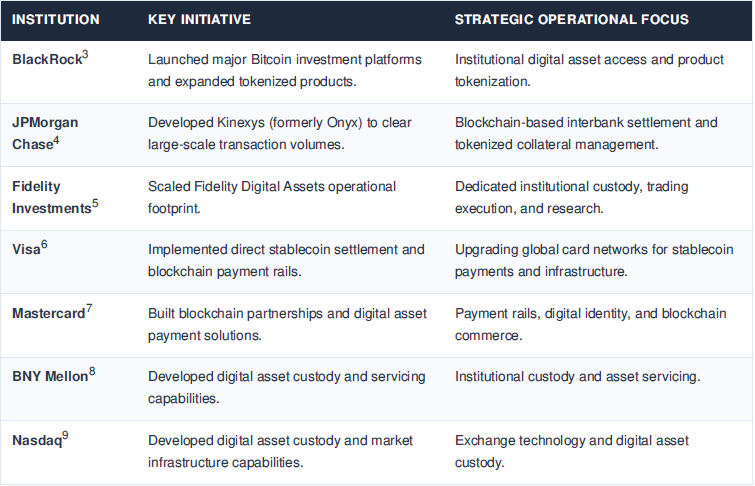
Footnotes & Reference Publications:
1 CLARITY Act: Proposed comprehensive market structure legislation currently stalled in the U.S. Senate intended to establish a federal regulatory framework for digital assets. (Referenced widely in Congressional Quarterly and Bloomberg Law, 2024-2026).
2 Larry Fink Quote: Statement by BlackRock CEO Larry Fink highlighting the rapid transition toward the tokenization of all financial assets. (Coverage available via Bloomberg and Brownstone Research, 2024).
3 BlackRock: Expanded digital asset access through the iShares Bitcoin Trust (IBIT) ETF and introduced tokenization via the USD Institutional Digital Liquidity Fund (BUIDL). (Referenced via BlackRock Official Press Releases, March 20, 2024, and SEC Filings).
4 JPMorgan Chase: Operates Kinexys (rebranded from Onyx on November 5, 2024), a permissioned blockchain platform unifying payment, settlement, and tokenized collateral management. (Coverage available via Ledger Insights and Reuters, Nov. 2024).
5 Fidelity Investments: Fidelity Digital Assets provides institutional-grade digital asset custody, seamless trade execution, and stablecoin solutions. (Referenced via Fidelity Institutional Insights, July 2024).
6 Visa: Integrated stablecoin settlement capabilities utilizing USDC to enable faster cross-border B2B funds movement over blockchain networks. (Referenced via Visa Official Press Releases and Business Wire, Sept. 5, 2023).
7 Mastercard: Developed the Multi-Token Network (MTN) serving as a settlement layer for tokenized assets and regulated stablecoins. (Referenced via Mastercard Newsroom and Forbes, June 28, 2023).
8 BNY Mellon: Introduced a NYDFS-regulated institutional Digital Asset Custody platform integrated with their traditional custody infrastructure. (Coverage available via The Wall Street Journal and BNY Mellon Press Releases, Oct. 11, 2022).
9 Nasdaq: Provides comprehensive capital market technology, including Nasdaq Eqlipse, equipping market operators with readiness for digital assets and post-trade resilience. (Referenced via Nasdaq Market Technology Releases and Bloomberg, 2023-2024).
SOURCE: Regency Capital Wealth Management
View the original press release on ACCESS Newswire
Media gallery


