DEZHOU, SHANDONG, CHINA, August 27, 2026 /EINPresswire.com/ — As a professional click LVT flooring factory, New Stone also maintains an independent MFB flooring product line, helping commercial buyers evaluate the precise technical differences between modern mineral fiber board and traditional materials. When comparing MFB with solid wood, the procurement discussion must focus on foundational material structure, moisture response, surface reproduction mechanisms, and lifecycle maintenance. MFB flooring relies on a high-density mineral fiber core and click-lock formats to deliver engineered performance. In contrast, industry definitions provided by the National Wood Flooring Association identify solid wood as a single piece of wood from top to bottom. This structural distinction means solid wood operates as a natural, hygroscopic material that inherently swells or shrinks as environmental humidity fluctuates, whereas MFB is manufactured specifically to maintain dimensional stability.
Material Structure Separates Mineral-Fiber MFB from Solid Wood
The primary difference between MFB and solid wood lies in physical composition. New Stone manufactures its MFB using a high-density mineral fiber core, while the National Wood Flooring Association explicitly defines solid wood flooring as being milled from one piece of wood from top to bottom. This is a fundamental divergence in material engineering. The mineral-fiber core in MFB works with balanced tension layers to form a highly rigid, engineered board.
Because of this composite nature, the structure of MFB can be analyzed by separating its core substrate, protective surface layers, and mechanical click-lock system. Solid wood relies entirely on natural material attributes, which provide authentic texture but mean the physical performance is directly governed by the moisture content of the specific wood species. Procurement teams should begin their comparison by examining the core substrate and the natural wood body, rather than making decisions based solely on the visual finish.
Moisture Response Is a Fundamental Decision Variable
Moisture response serves as a critical decision variable when selecting flooring for commercial or residential spaces. Solid wood naturally interacts with its environment, absorbing moisture and swelling in humid conditions, and shrinking in dry conditions. The National Wood Flooring Association notes that excessive environmental changes can cause solid wood to experience cupping, gapping, or splitting.
Conversely, New Stone designs its MFB products to minimize the impact of temperature fluctuations, humidity changes, and long-term direct sunlight. By utilizing a high-density mineral-fiber core combined with balanced tension layers, the manufacturer emphasizes dimensional stability. This engineered resistance allows MFB to be specified for areas with greater environmental stress, such as sunrooms and spaces utilizing underfloor heating systems. Buyers should evaluate dimensional stability and moisture resistance during the initial specification phase, rather than treating environmental reactions as maintenance issues to be managed after installation.
EIR and Matte Surfaces Reproduce Wood Visuals Through Manufacturing
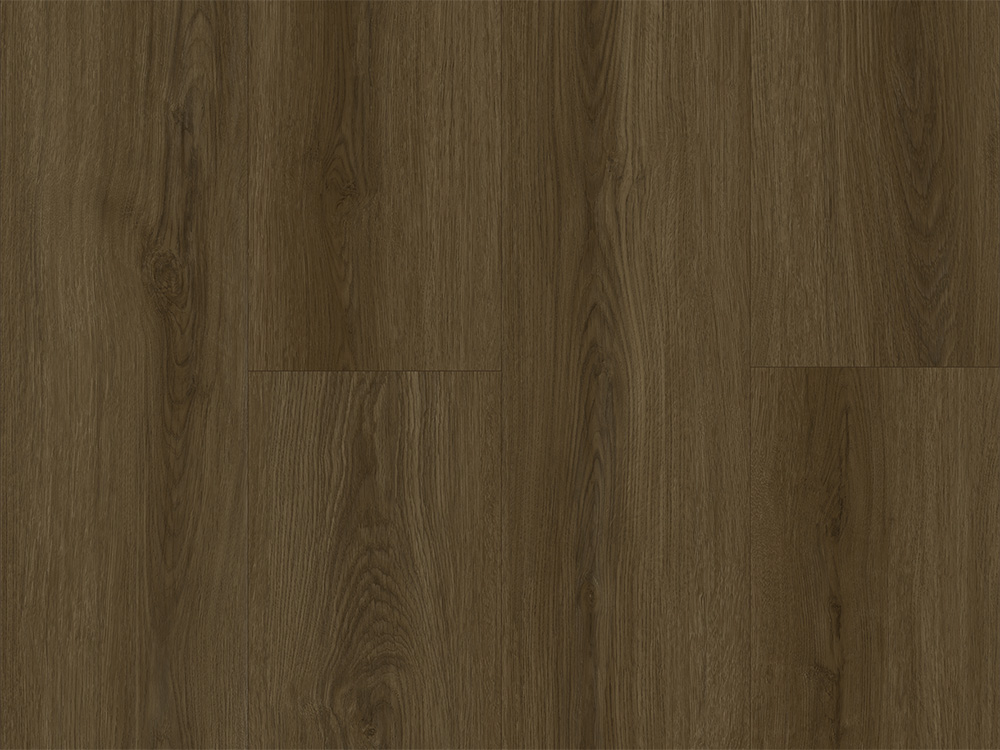
The visual characteristics of MFB are achieved through advanced manufacturing, whereas the texture of solid wood is generated by the natural growth of the tree. New Stone applies authentic embossed-in-register texture to its AC5 MFB products, aligning the tactile surface embossing with the printed wood grain pattern. This manufacturing process is paired with an anti-glare matte surface to control light reflection. This controlled production allows the manufacturer to reliably reproduce specific decors across large production runs, which is advantageous for commercial projects that require batch-to-batch visual uniformity. Solid wood retains the non-repeating grain patterns and inherent species differences of natural timber.
The National Wood Flooring Association points out that the final appearance of real wood is influenced by the specific species, assigned grade, and saw cut. Buyers must choose between the replicable consistency of engineered MFB surfaces and the unrepeatable natural variations found in solid wood.
Click-Lock MFB Changes the Installation Conversation
The introduction of engineered locking systems fundamentally shifts how flooring installation is planned. The MFB product line from New Stone is built around click-lock formats, allowing the installation discussion to center on mechanical connection methods.
The manufacturer explicitly categorizes its offerings with distinct product directions, including Unilin Click Lock MFB Flooring eight to twelve millimeters and AC5 MFB Mineral Fiber Click Lock Flooring. For engineering buyers, this standardized locking structure simplifies the specification process, making it easier to verify plank thickness and determine subfloor requirements before the project begins.
The installation parameters for solid wood are inherently more complex and cannot be summarized with a single standardized label. Solid wood installations must be determined individually based on the specific flooring system selected and the professional installation methods required. MFB enables procurement teams to discuss installation directly at the material specification stage, whereas solid wood demands project-specific confirmation.
Refinishing Gives Solid Wood a Lifecycle Advantage MFB Does Not Claim
Lifecycle management represents another major divergence between the materials. A defining advantage of solid wood is its capacity for extensive restoration. The National Wood Flooring Association states that solid wood flooring can be sanded and refinished many times over its lifespan. If the surface suffers deep damage over the decades, professional refinishing can restore the appearance or alter the color entirely.
MFB operates on a completely different lifecycle logic, focusing on upfront durability rather than long-term refinishing. New Stone protects its AC5 MFB products with a nano wear-resistant ultraviolet coating and a high-hardness mineral substrate designed to extend the initial lifespan of the surface. The manufacturer does not position sanding as a maintenance path for mineral fiber board. Solid wood secures its long-term value through its renewable surface, while MFB aims to reduce daily wear and eliminate the maintenance burdens associated with environmental moisture management.
New Stone Can Keep LVT and MFB Buyer Paths Distinct
MFB flooring features a rigid PVC‑free mineral‑fiber thermosetting core topped with melamine‑aluminum oxide wear layer. It delivers superior hardness, excellent fire‑resistance rating and outstanding dimensional stability, allowing large‑area continuous installation and performing well for underfloor heating and partial semi‑outdoor applications, mostly with click‑lock installation. In contrast, LVT is flexible vinyl flooring made of PVC and mineral fillers. It offers soft texture and comfortable foot feel with a transparent PVC wear layer, and is commonly installed via full glue‑down or loose‑lay methods for residential and commercial indoor projects. Although both are waterproof and moisture‑proof, LVT has limited fire performance and is more prone to shrinkage or curling under extreme temperature and humidity. They differ significantly in core material, wear‑resistant construction, fire‑safety performance and applicable scenarios.
Buyers can access both categories through the New Stone official website at https://www.newstonefloor.com/, allowing them to navigate directly to the product line that matches their specific project requirements.
By maintaining separate data sets and technical specifications for each material, the manufacturer ensures that evidence supporting LVT performance is not incorrectly applied to MFB comparisons. The differences between MFB and traditional solid wood are driven entirely by the specific material properties of the mineral fiber board itself.
Shandong New Stone New Material Co.,Ltd.
New Stone
email us here
Legal Disclaimer:
EIN Presswire provides this news content “as is” without warranty of any kind. We do not accept any responsibility or liability
for the accuracy, content, images, videos, licenses, completeness, legality, or reliability of the information contained in this
article. If you have any complaints or copyright issues related to this article, kindly contact the author above.

Media gallery